
Sterling Silver vs. Pure Silver: What Is the Difference?
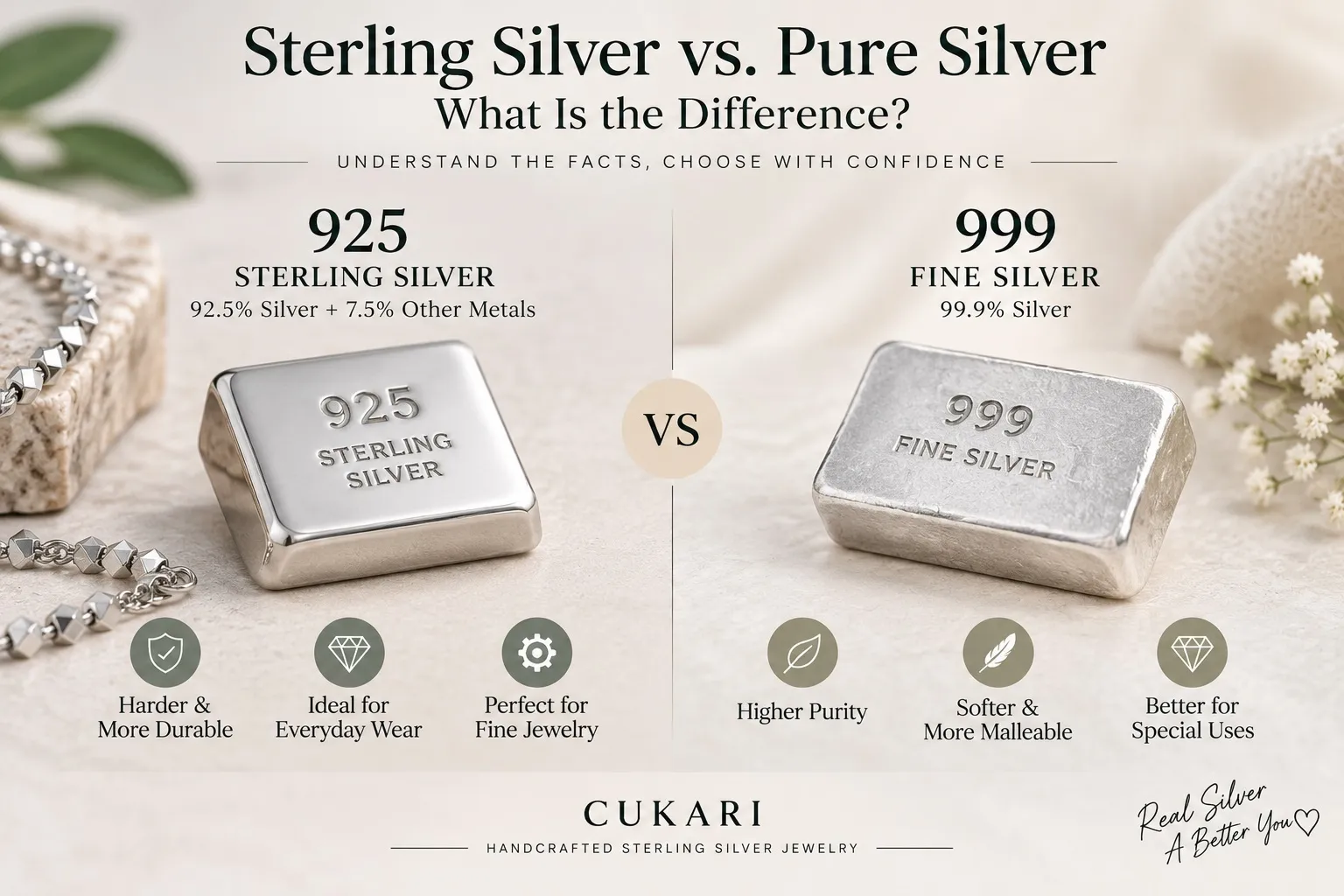
When shopping for silver jewelry, you will often come across two different purity marks: 925 and 999. At first, the choice may seem straightforward. If 999 silver is 99.9% pure silver and 925 sterling silver is 92.5% silver, it is easy to assume that the higher number automatically represents the better material.
For jewelry, however, purity is only part of the story.
The difference between 999 fine silver and 925 sterling silver affects much more than the number stamped on a piece. Their different compositions influence hardness, durability, workability, and how well each material performs in everyday jewelry. A higher silver content can be desirable, but it can also make the metal softer and more susceptible to bending or scratching.
That is why the better question is not simply, Which one contains more silver? It is which material is better suited to the type of jewelry you want and the way you plan to wear it?
This guide explains the differences between 925 sterling silver and 999 fine silver, including purity, durability, appearance, tarnish, value, and everyday wear, so you can make a more informed choice rather than judging silver solely by its fineness number.
Table of Contents
What Is Pure Silver?
Pure silver, often referred to as fine silver, is silver with a very high level of purity. A fineness mark of 999 generally indicates that the metal contains 99.9% silver, with only a very small proportion of other elements remaining.
The 999 designation uses the same parts-per-thousand system used for many precious metals. In practical terms, 999 means that 999 parts out of every 1,000 are silver. By comparison, sterling silver has a fineness of 925, meaning 925 parts per 1,000 are silver.
The main characteristic that distinguishes fine silver from sterling silver is not its appearance but its physical properties. Silver is naturally a relatively soft and malleable metal, and the high purity of fine silver means there is little alloying metal present to increase its hardness.
That softness can be useful in certain applications because fine silver is easy to shape and work with. At the same time, it means a piece made from 999 silver can be more susceptible to scratching, bending, or deformation than a comparable piece made from a harder silver alloy.
For jewelry, this distinction matters because a material that is easy to shape during production is not necessarily the material that will perform best under frequent everyday wear.
What Is 925 Sterling Silver
925 sterling silver contains 92.5% silver, with the remaining 7.5% consisting of other metals added to create a harder and more practical alloy. Copper is one of the metals commonly used for this purpose.
The addition of alloying metal does not make sterling silver “fake silver” or remove it from the category of genuine silver. It changes the physical characteristics of the material so that it can better withstand the demands of jewelry making and regular use.
The U.S. Federal Trade Commission recognizes “silver,” “sterling,” and “sterling silver” as descriptions for products containing 92.5% pure silver, and explains that a 925 mark represents 925 parts pure silver per thousand.
This is an important distinction because people sometimes interpret the 7.5% alloy content as a disadvantage. In reality, the alloy serves a practical purpose. Jewelry needs to be shaped, polished, engraved, formed, and worn, and a material that is slightly harder can be much better suited to those requirements.
If you are looking specifically for an explanation of the 925 mark, you can read Cukari’s guide to what 925 means on silver jewelry. The focus here is different: instead of simply explaining the number, we are looking at why 925 sterling silver and 999 fine silver behave differently.
925 vs. 999: Understanding the Purity Difference
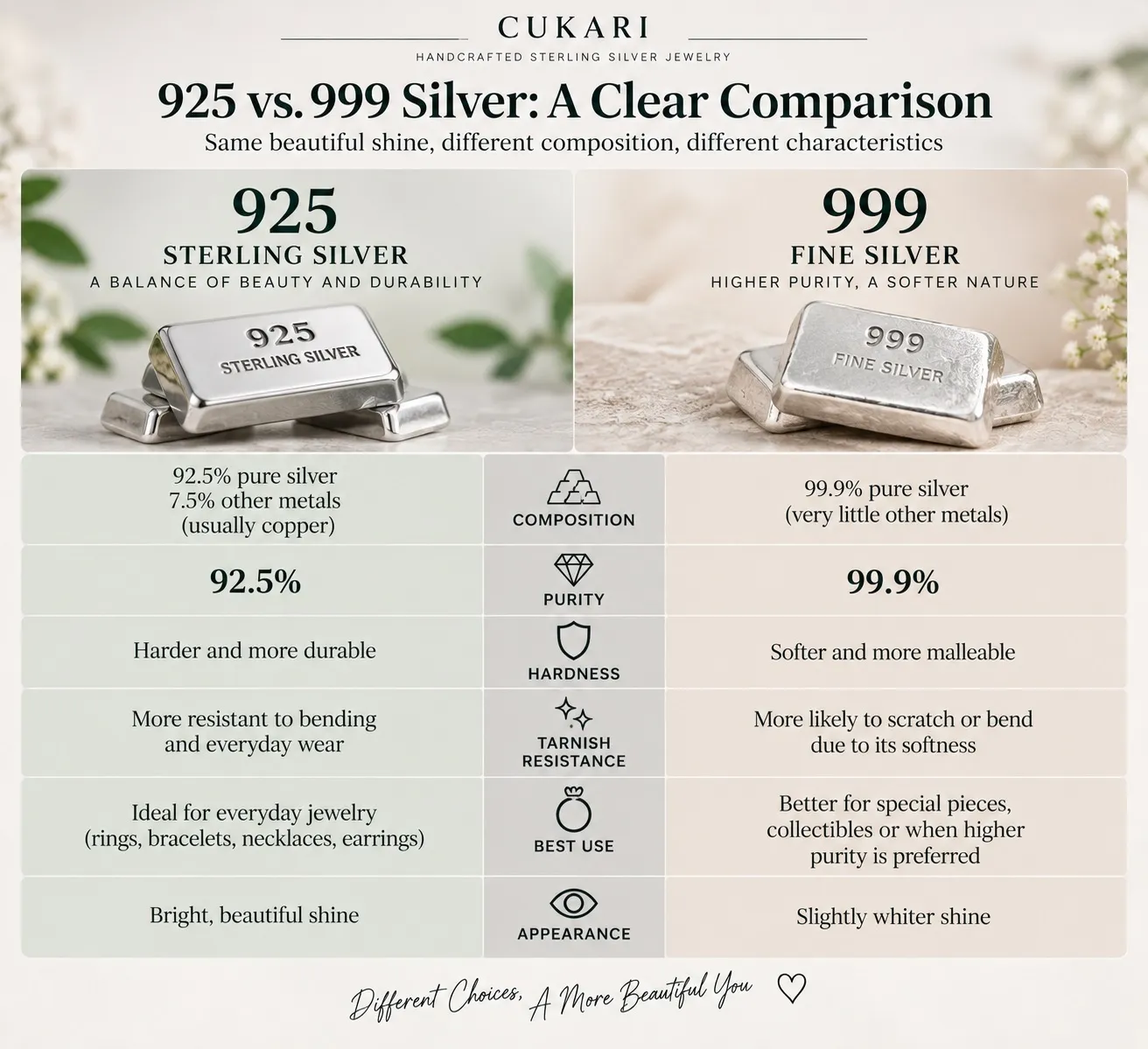
The numerical difference between the two materials is simple, but its practical meaning is worth understanding.
| Silver Type | Silver Content | Common Name | General Characteristics |
|---|---|---|---|
| 999 | 99.9% | Fine silver / pure silver | Higher purity, softer and more malleable |
| 925 | 92.5% | prata de lei | High silver content, harder and more practical for regular wear |
| 900 | 90% | Coin silver | Lower silver content than sterling silver |
A 999 mark tells you that the material has a higher silver content than sterling silver. A 925 mark tells you that the material is a sterling silver alloy containing 92.5% silver.
The difference of 7.4 percentage points may look small, but those additional alloying metals can significantly change how the material behaves. This is why silver purity should not be treated as a simple quality scale in which 999 is automatically “better” and 925 is automatically “worse.”
If you are buying bullion or collecting silver primarily for its metal content, purity can understandably be one of the most important considerations. When you are buying a ring, bracelet, necklace, or pair of earrings, however, the physical characteristics of the alloy become much more relevant.
Why Is Pure Silver Softer?
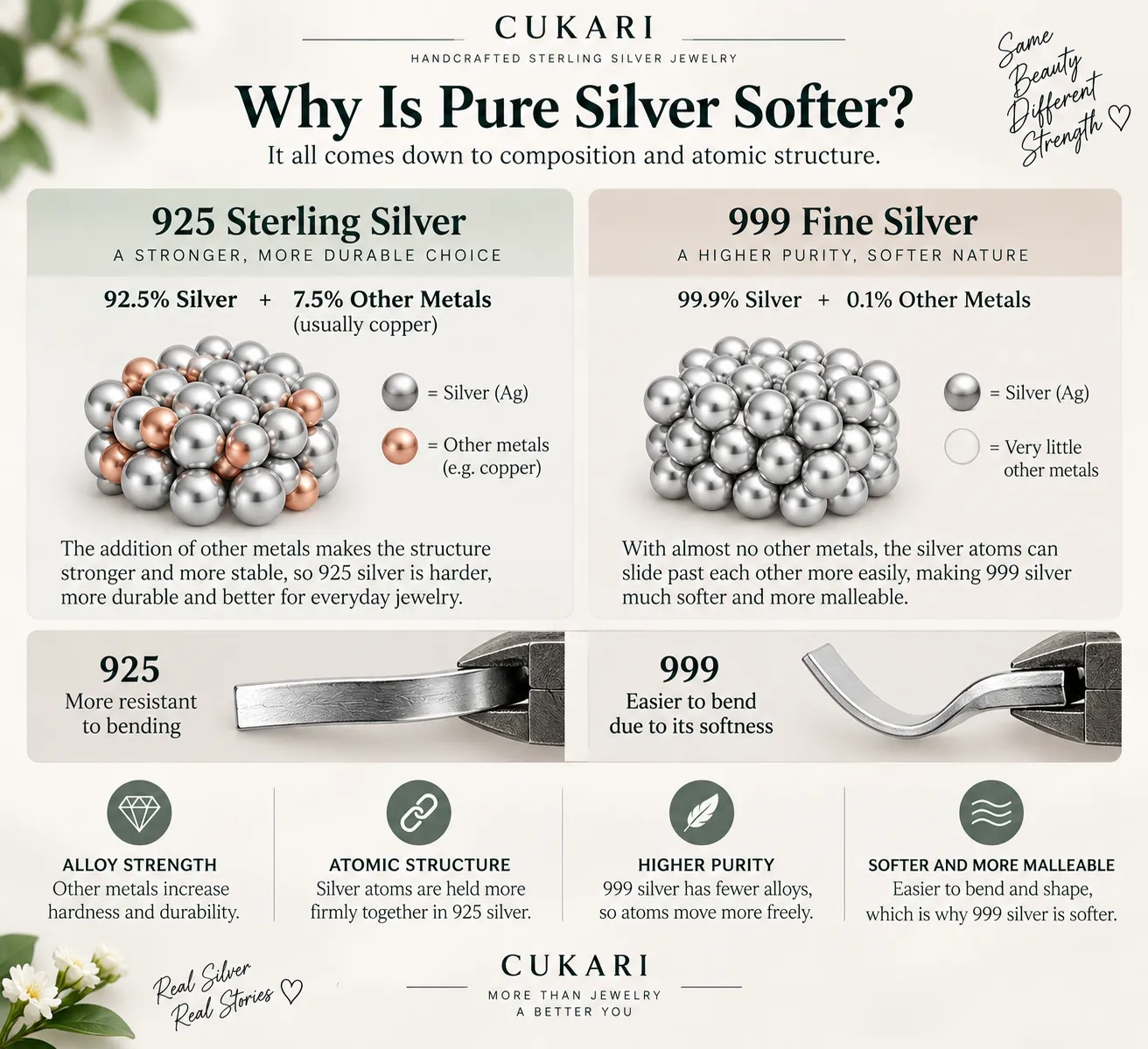
The softness of fine silver comes directly from the characteristics of silver itself. Pure silver is highly malleable, which means it can be shaped relatively easily without breaking. That property is useful for certain types of metalworking, but it also means the finished material is less resistant to deformation.
A thin piece of fine silver, for example, can be easier to bend than the same design made from sterling silver. A ring may be more vulnerable to dents, while raised details or delicate surfaces can show scratches more easily when the piece is exposed to repeated contact with harder materials.
Sterling silver addresses some of this limitation by introducing alloying metals. Copper is commonly used because it increases hardness while allowing the finished material to retain the appearance and high silver content people expect from sterling silver.
This illustrates an important principle when comparing precious metals: purity and hardness are different properties. Increasing the percentage of silver does not automatically make the finished jewelry stronger. In some applications, reducing purity slightly in order to create a more durable alloy is a deliberate design choice rather than a compromise in quality.
Which Is More Durable for Jewelry?
When durability is an important consideration, 925 sterling silver is generally the more practical choice for jewelry.
This does not mean sterling silver is scratch-proof or impossible to bend. Silver jewelry can still show signs of wear, particularly when it is worn frequently or exposed to hard surfaces. The difference is that sterling silver is harder than fine silver, so it is generally better able to maintain its shape under normal use.
This matters particularly for jewelry that comes into regular contact with the surrounding environment. Rings can rub against desks, door handles, phones, and other objects throughout the day. Bracelets move against clothing and surfaces, while necklaces and pendants are repeatedly handled when they are put on or removed.
For these types of applications, the additional hardness provided by the alloy can be more useful than the additional silver content of fine silver.
The choice also depends on the design itself. A thick, simple piece may behave differently from a very thin or highly detailed piece, even when both are made from the same material. Weight, thickness, construction, and workmanship all contribute to how durable a finished piece feels.
Which Is Better for Everyday Wear?
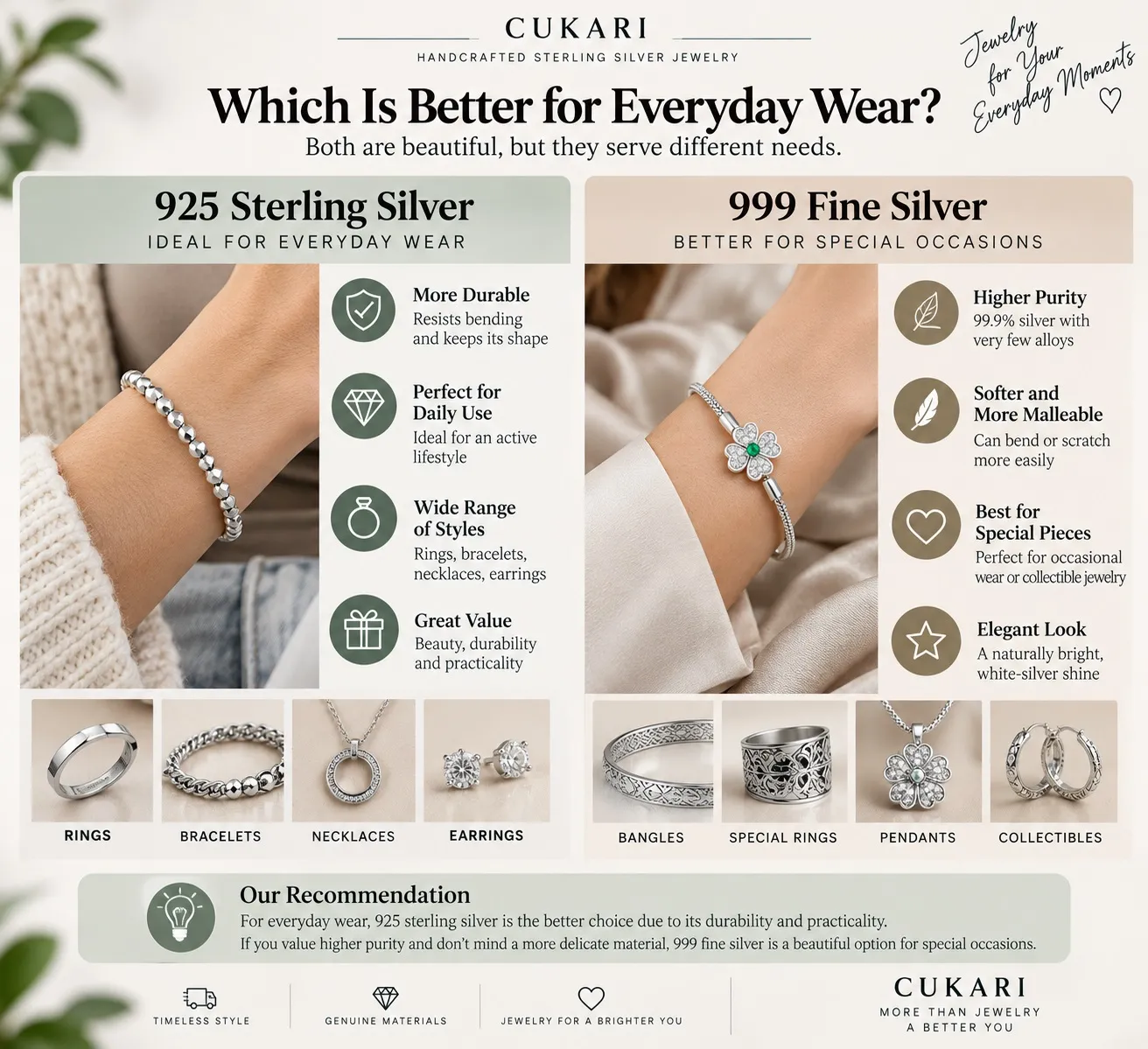
For jewelry intended to become part of your regular wardrobe, 925 sterling silver generally offers the better balance between purity and practicality.
A ring or bracelet worn several times a week has to deal with far more physical contact than a piece that is only worn on special occasions. It may be exposed to clothing, skin, furniture, bags, and everyday objects, and it is also more likely to be taken on and off repeatedly.
Fine silver can certainly be worn, but its softness makes it less forgiving when the jewelry needs to maintain a particular shape over time. Sterling silver is harder, which is one reason it has become such a widely used material for everyday jewelry.
This is particularly relevant when choosing pieces such as bracelets, rings, and bangles. For example, Cukari’s women’s sterling silver bracelets include a range of styles and constructions designed around the practical characteristics of 925 sterling silver.
The same reasoning applies to women’s sterling silver rings e women’s sterling silver necklaces. The fact that these pieces are made from an alloy rather than nearly pure silver is not a sign that they contain inferior metal; it is part of what makes sterling silver suitable for wearable jewelry.
Does Pure Silver Look Different From Sterling Silver?
In most cases, the difference in appearance is not obvious simply by looking at the finished jewelry.
Both fine silver and sterling silver can have the bright, reflective appearance traditionally associated with silver. When two pieces have been polished to a similar finish, most people would not be able to determine their purity simply by looking at them.
The surface appearance of jewelry is influenced by many factors besides silver content. Polishing, texture, oxidation, engraving, finishing techniques, and the condition of the surface can all change how reflective or bright a piece looks.
This is why appearance alone is not a reliable way to determine whether jewelry is 925 or 999 silver. A piece can look bright and expensive without having a particularly high silver content, while a genuine sterling silver piece can develop a darker surface over time as it tarnishes.
When purity matters to you, look at the hallmark, product specifications, and information provided by the seller rather than relying on appearance alone.
Does 999 Silver Tarnish Less Than 925 Silver?
It is tempting to assume that a higher-purity silver will automatically resist tarnishing better, but the relationship is not that simple.
Both fine silver and sterling silver can develop tarnish. Silver reacts with substances in its environment, and factors such as humidity, sulfur-containing compounds, cosmetics, chemicals, and storage conditions can influence how quickly the surface changes.
Sterling silver contains alloying metals, which can also affect the way the surface reacts with its surroundings. However, this does not mean that 999 fine silver is immune to tarnishing.
Nor does the appearance of tarnish mean that the jewelry is fake.
A silver piece may gradually become darker or lose some of its brightness, particularly when it is stored for long periods or exposed to certain environmental conditions. With appropriate cleaning and storage, the original appearance can often be restored.
For a more detailed explanation of why silver jewelry becomes dark, see Cukari’s guide Why Sterling Silver Jewelry Turns Black.
The key point is that silver purity and tarnish resistance should not be treated as the same thing. A higher fineness number tells you how much silver is present; it does not guarantee that the surface will never change.
Is 999 Silver More Valuable Than 925 Silver?
If you compare the silver content by weight, 999 fine silver contains more actual silver than 925 sterling silver. That is simply a consequence of the different purity levels.
However, the value of finished jewelry cannot be determined from purity alone.
A jewelry piece has value not only because of the metal it contains but also because of its weight, craftsmanship, design, construction, gemstones if present, finishing, brand, and sometimes its rarity or collectibility.
Imagine two silver rings that look completely different. One is a lightweight 999 fine silver band with a simple finish, while the other is a heavier handmade sterling silver ring with intricate carving and substantial workmanship. The 999 ring contains a higher percentage of silver, but that fact alone does not tell you which finished piece should be considered more valuable.
For consumers, this is an important distinction. Higher silver purity means a higher proportion of silver in the material; it does not automatically mean a higher-quality piece of jewelry or a better purchase.
If your primary goal is acquiring silver based on metal content, purity may deserve greater emphasis. If your goal is finding jewelry to wear and enjoy, the material’s durability and the quality of the finished piece may matter much more.
When Does Pure Silver Make More Sense?
There are situations in which 999 fine silver is an attractive choice. If your main priority is having the highest practical silver purity, fine silver clearly has the advantage. Some buyers also specifically appreciate its softness and malleability, particularly in designs or applications where maximum hardness is not necessary.
Fine silver can also be appropriate for jewelry that is worn occasionally and handled carefully. In those circumstances, the disadvantages of a softer material may be less important.
The decision changes when the jewelry is expected to withstand frequent everyday use. A bracelet that is worn several times a week, for example, faces more opportunities for contact and deformation than a decorative piece that spends most of its time stored safely.
For that reason, 925 sterling silver is often the more practical material for everyday rings, bracelets, necklaces, earrings, and other wearable pieces.
The choice ultimately comes down to what you value more: maximum silver purity or a balance between silver content and physical performance.
Which Should You Choose: 925 or 999?
There is no universal winner between 925 sterling silver and 999 fine silver because they serve somewhat different priorities.
If you are looking for jewelry that you can wear regularly, 925 sterling silver is usually the more practical choice. It still contains a high percentage of silver, while the additional alloying metals provide greater hardness and help the material maintain its shape during normal use. This makes sterling silver particularly suitable for rings, bracelets, bangles, necklaces, and earrings that form part of an everyday wardrobe.
If maximum silver purity is your main consideration, 999 fine silver has the clear advantage. Its 99.9% silver content makes it purer than sterling silver, but that higher purity also comes with greater softness. You may need to handle and store fine silver jewelry more carefully, particularly when the design is thin or delicate.
For most people choosing wearable jewelry, the decision can therefore be simplified:
| If your priority is… | The more suitable choice is… |
|---|---|
| Maximum silver purity | 999 fine silver |
| Everyday wear | prata de lei 925 |
| Greater resistance to bending | prata de lei 925 |
| Softer, highly malleable silver | 999 fine silver |
| A balance of purity and durability | prata de lei 925 |
| Silver content as the primary concern | 999 fine silver |
Neither choice is inherently “better.” The important thing is whether the material’s characteristics match the purpose of the jewelry.
Common Misunderstandings About Silver Purity
“999 silver is always better than 925.”
A higher purity level does not automatically make a material better for every application. 999 fine silver contains more silver, but 925 sterling silver is harder and is generally more practical for jewelry that receives regular wear.
“925 silver isn’t real silver.”
This is incorrect. Sterling silver is a genuine silver alloy containing 92.5% silver. The remaining alloying metal is added to improve the material’s physical characteristics rather than to replace silver entirely.
“Pure silver means 100% silver.”
In jewelry terminology, 999 fine silver generally means 99.9% silver, rather than literally 100.000% silver. The remaining fraction consists of trace elements.
“The higher the purity, the stronger the jewelry.”
Purity and strength are separate properties. Fine silver has a higher silver content, but sterling silver is harder because of its alloy composition.
“925 and 999 silver look completely different.”
Usually they do not. A polished piece of 925 sterling silver can look very similar to a polished piece of 999 fine silver. Surface finish and design often have a much greater effect on appearance.
Frequently Asked Questions About 925 and 999 Silver
Is 925 sterling silver better than 999 pure silver?
Neither is universally better. 999 fine silver offers higher silver purity, while 925 sterling silver provides greater hardness and is generally better suited to everyday jewelry. The right choice depends on whether purity or practicality matters more to you.
Is 999 silver worth more than 925 silver?
By weight, 999 silver contains more silver than 925 sterling silver. However, the price and value of finished jewelry depend on additional factors such as weight, craftsmanship, design, gemstones, and construction.
Can 999 silver be used for rings?
Yes. Fine silver can be used to make rings, although its softness means it may be more susceptible to scratches, dents, and deformation than a comparable sterling silver ring.
Why is sterling silver only 92.5% silver?
The remaining 7.5% consists of alloying metals that help improve the hardness and practical performance of the material. Copper is commonly used in sterling silver alloys.
Does 925 sterling silver contain real silver?
Yes. Sterling silver contains 92.5% silver. The 925 fineness mark indicates that 925 parts out of every 1,000 are silver.
Does 999 silver tarnish?
Yes. Fine silver can tarnish over time. Its high purity does not make it completely immune to reactions with substances in the surrounding environment.
Is 925 silver good for everyday wear?
Yes. Its combination of high silver content and greater hardness makes 925 sterling silver a practical material for many types of jewelry intended for regular use.
Which is better for a silver bracelet, 925 or 999?
For a bracelet intended to be worn regularly, 925 sterling silver is generally the more practical option because it provides a useful balance between silver purity and durability.
What Matters More Than the Number?
When people compare 925 and 999 silver, it is easy to focus entirely on the number because purity seems like something that can be ranked objectively. More silver sounds better, and 999 is clearly higher than 925.
For jewelry, however, that way of thinking leaves out one of the most important parts of the decision: how the material is going to be used.
999 fine silver gives you a higher proportion of silver and is an excellent choice when maximum purity is the priority. Its softness, however, can make it less forgiving when the jewelry is subjected to frequent contact or pressure.
925 sterling silver contains slightly less silver, but the addition of alloying metals gives it greater hardness and makes it more suitable for many forms of everyday jewelry. That balance between purity and practicality is one of the main reasons sterling silver has remained such a widely used jewelry material.
So if you are choosing between the two, there is no need to think of 925 as an inferior version of 999. They are different materials designed around different characteristics.
If your priority is the highest silver purity, 999 makes sense. If you want a high-silver-content material that is better suited to regular wear, 925 sterling silver is often the more practical choice.
In other words, the highest number is not always the most useful number.
When choosing jewelry, look beyond the hallmark and consider the design, construction, intended use, craftsmanship, and how often you expect to wear the piece. Once you do that, the difference between 925 and 999 becomes much easier to understand.