
What Does 925 Mean on Silver Jewelry? Understanding 925 Sterling Silver
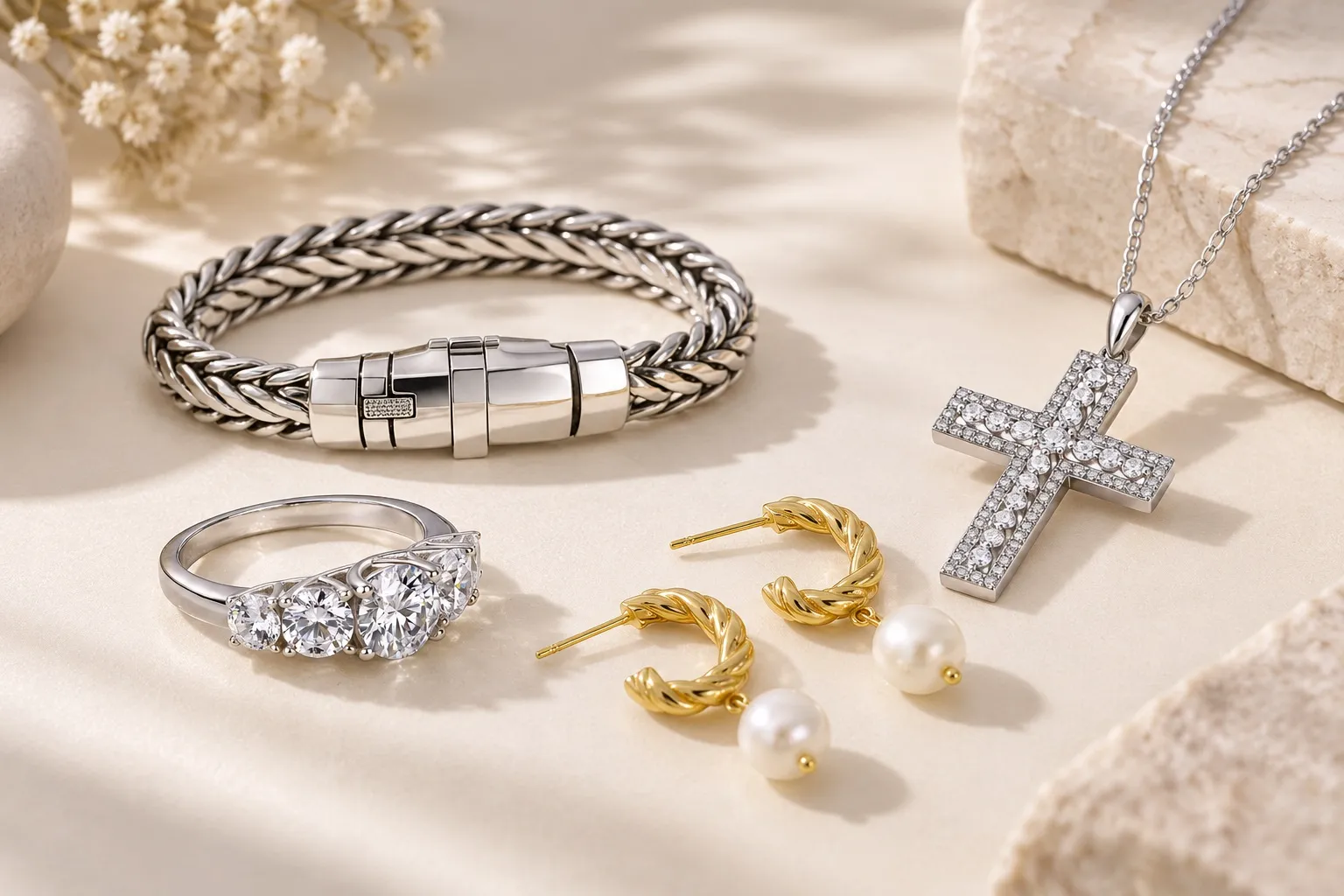
When you look at a silver ring, bracelet, necklace, or pair of earrings, you may notice a tiny number stamped somewhere on the piece: 925.
For many shoppers, that number is familiar but not entirely clear. Does 925 mean the jewelry is pure silver? Is it the same thing as sterling silver? Why is jewelry made with 92.5% silver instead of 100% silver? And if a piece is stamped 925, does that automatically mean it is genuine?
These are reasonable questions, especially when buying silver jewelry online. The number is small, but it tells you something important about the metal itself.
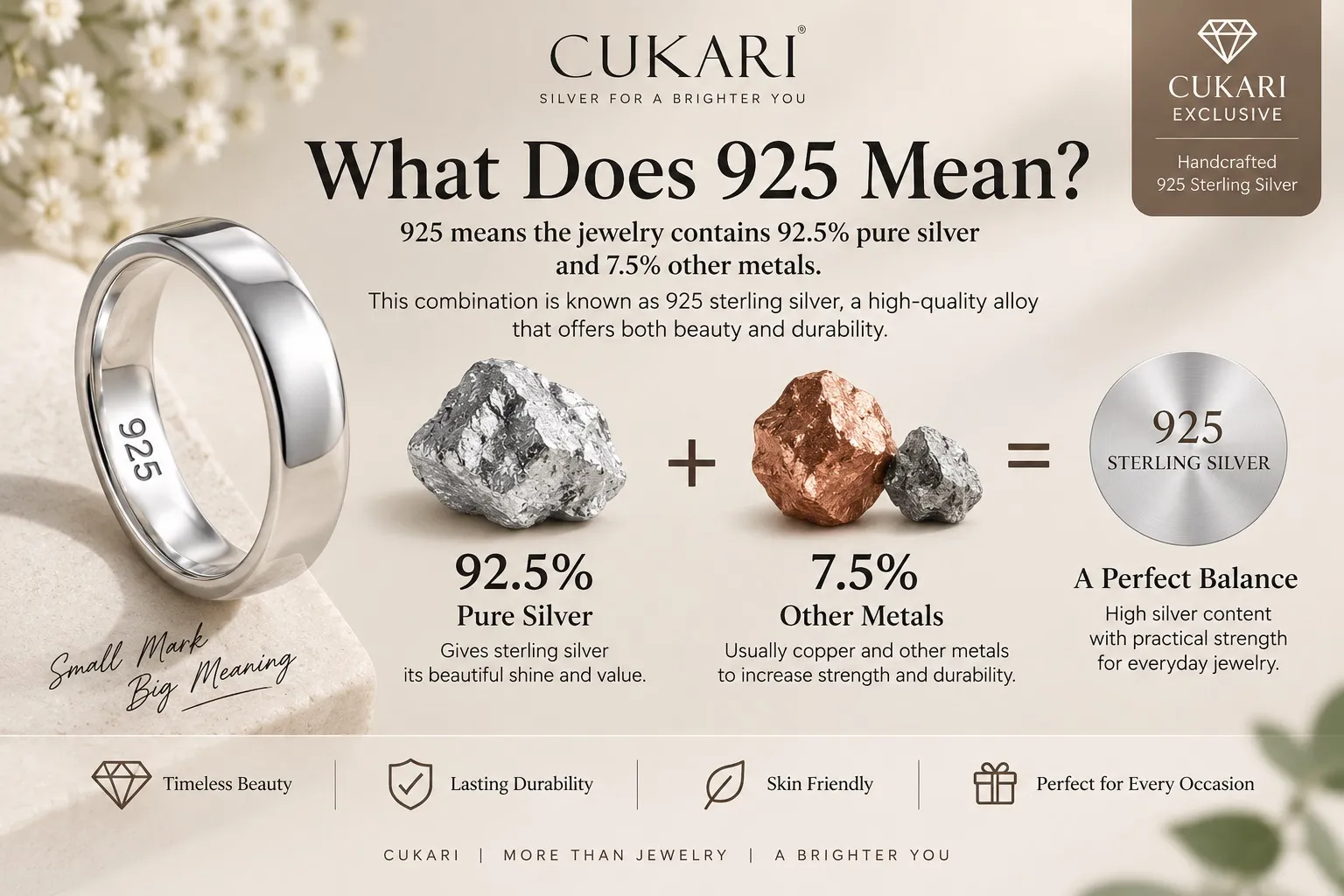
925 refers to the proportion of pure silver in the metal alloy. Sterling silver contains 92.5% pure silver, which is why it is commonly identified as 925 silver or S925. The remaining 7.5% consists of other metals added to improve the physical properties of the material, making it more practical for jewelry than pure silver alone. The U.S. Federal Trade Commission likewise explains that “sterling” and “sterling silver” describe products containing 92.5% pure silver, while a 925 mark represents 925 parts of pure silver per thousand.
But there is more to the story than simply knowing that 925 means 92.5%. Understanding why sterling silver is made this way, how it compares with other silver materials, what the stamp can and cannot tell you, and how the metal behaves over time will make it much easier to choose silver jewelry with confidence.
Table of Contents
What Does 925 Mean on Silver Jewelry?
The number 925 means that the metal contains 925 parts pure silver out of every 1,000 parts of the alloy. Expressed as a percentage, that is 92.5% silver.
The remaining 7.5% is made up of other metals. Copper is traditionally associated with sterling silver alloys because it can increase hardness and strength while allowing the material to retain a high silver content. The exact alloy composition can vary depending on the manufacturer and applicable standards, so it is better to think of 925 as a statement about the minimum silver proportion rather than as a guarantee that every piece uses exactly the same combination of additional metals.
This is also why 925 does not mean that a piece is 92.5% silver-plated. The number describes the composition of the metal alloy itself. That is an important distinction when comparing sterling silver with silver-plated jewelry, where silver is applied as a surface layer over another material. The FTC specifically distinguishes sterling silver from products that merely have a silver coating.
So when you see a bracelet described as 925スターリングシルバー, the useful question is not “Is it real silver or fake silver?” The more accurate question is whether the product genuinely meets the sterling silver standard it claims to meet.
Why Is Sterling Silver 92.5% Silver Instead of 100%?
At first glance, it might seem that jewelry made from 100% silver would automatically be better than jewelry containing 92.5% silver.
The problem is that pure silver is relatively soft. That softness can be useful for certain purposes, but it is not ideal for many pieces of jewelry that are expected to hold their shape, resist everyday knocks, and support detailed designs.
Imagine trying to make a thin ring, a delicate chain, or a bracelet clasp entirely from a very soft metal. The piece could be beautiful when new, but it would be more vulnerable to bending, scratching, and deformation during ordinary use.
Adding a small proportion of other metals changes the physical characteristics of the material. Sterling silver therefore represents a practical compromise: it retains a very high silver content while becoming more suitable for jewelry making.
This is one reason 925 silver became such an important jewelry material. It allows designers to create everything from fine chains and earrings to substantial rings and handcrafted bracelets without sacrificing the characteristic appearance associated with silver.
The important point is that higher purity and better suitability are not always the same thing. A metal with a higher silver percentage is not automatically the better choice for every type of jewelry.
What Exactly Is 925 Sterling Silver Made Of?
At its simplest, sterling silver consists of 92.5% silver and 7.5% other alloying metals.
Historically, copper has been one of the most common metals used in sterling silver because it can improve hardness while maintaining the desirable appearance of silver. Modern jewelry alloys can vary, however, and manufacturers may use different formulations depending on the required properties of the finished product.
That distinction becomes particularly relevant when people ask whether all sterling silver jewelry behaves exactly the same way.
It does not.
Two bracelets can both be genuine 925 sterling silver but have noticeably different weights, finishes, hardness, surface treatments, and resistance to wear. One may be highly polished, another deliberately oxidized, and another gold-plated. The underlying silver standard may be the same even though the finished jewelry looks and behaves differently.
This is why the 925 mark should be understood as one piece of information about a piece of jewelry, not a complete description of the jewelry itself.
If you want to explore the broader family of silver materials, Cukari’s 純銀ジュエリーの選び方ガイド provides additional background on silver purity, alloys, finishes, and jewelry-making considerations.
925 Sterling Silver vs. Pure Silver
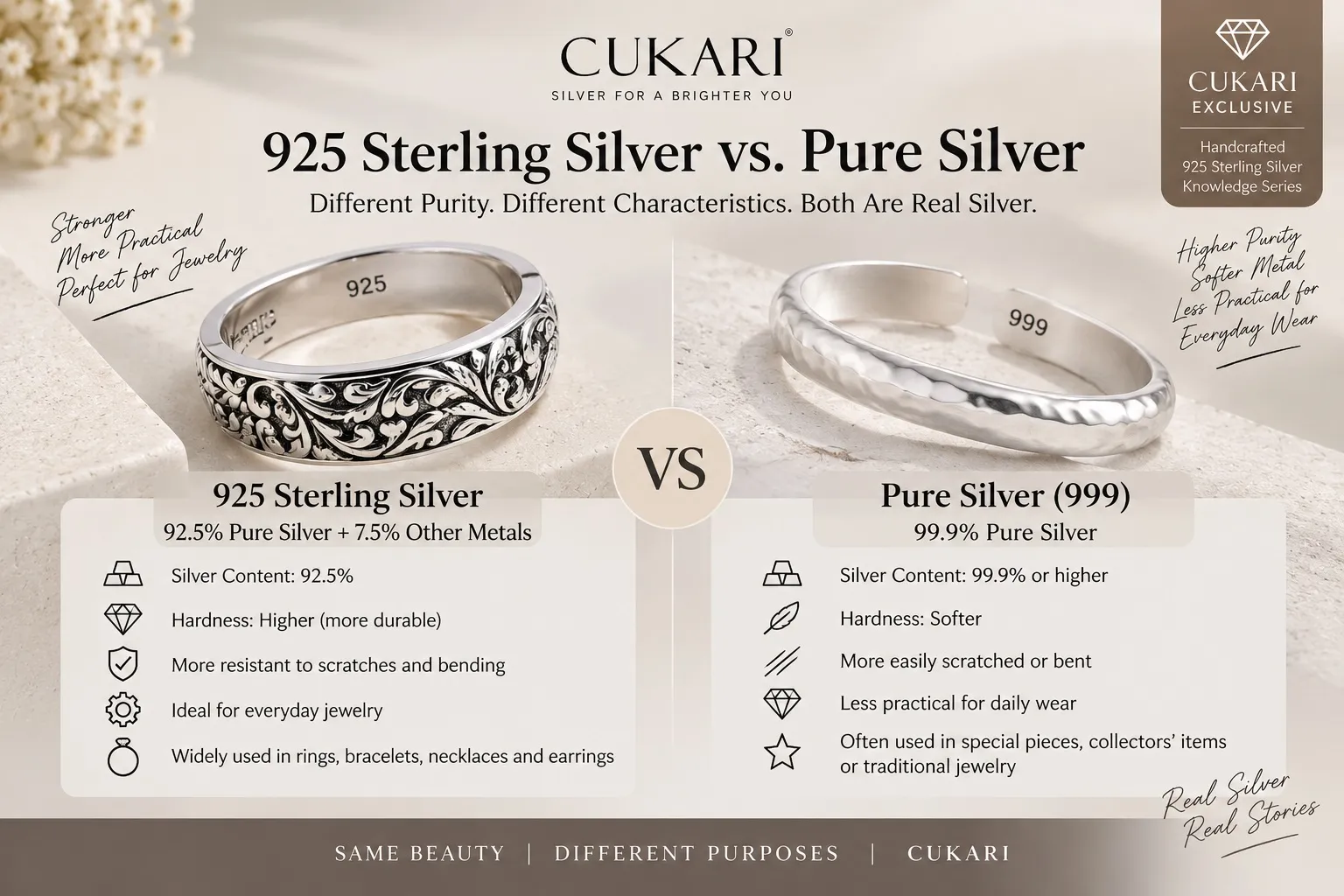
The difference between 925 sterling silver and fine or pure silver is mainly the proportion of silver and the resulting physical properties.
Fine silver is commonly sold as 999 or 999.9 silver, depending on the market and standard, meaning it contains approximately 99.9% or more silver. Sterling silver, by comparison, contains 92.5% silver.
That higher purity does not necessarily make fine silver the better material for a ring or bracelet.
Fine silver is softer, which can make it more vulnerable to scratches and deformation. Sterling silver sacrifices some purity in exchange for greater strength and practicality, which is why it is so widely used for jewelry.
A useful way to think about the difference is this:
| 材料 | Approximate silver content | Typical characteristic |
|---|---|---|
| Fine silver | 99.9% or higher | Very high purity, relatively soft |
| スターリングシルバー | 92.5% | High silver content with greater practicality for jewelry |
| 800 silver | 80% | Lower silver content, used in some markets and applications |
| Silver-plated | Surface coating | Silver layer over another base material |
The choice therefore depends on what you want from the jewelry. If your priority is the highest possible silver purity, fine silver is the more obvious choice. If you want a material that balances high silver content with the strength needed for everyday jewelry, sterling silver is generally more practical.
If you’re comparing sterling silver with fine silver in more detail, see our guide to Sterling Silver vs. Pure Silver: What Is the Difference?
925 Sterling Silver vs. Silver-Plated Jewelry
This is one of the most useful distinctions to understand when shopping online because the two can look almost identical in photographs.
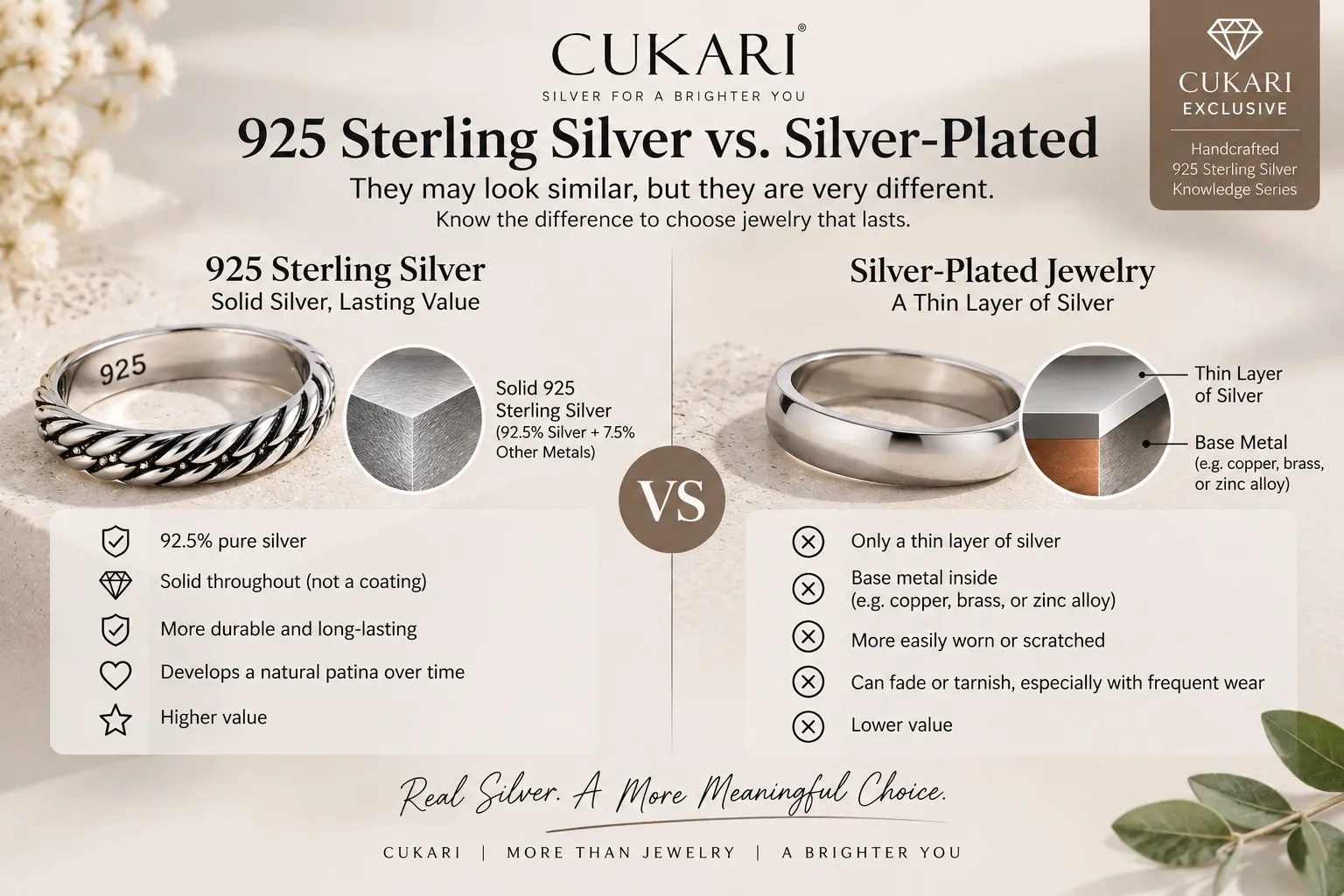
A sterling silver piece is made from a sterling silver alloy as its primary metal. A silver-plated piece, by contrast, has a layer of silver applied to a different base material.
The difference becomes more important as the jewelry is worn.
A plated surface can gradually wear away, particularly on areas that experience frequent friction. Once that happens, the underlying metal may become visible. The appearance and durability of a plated item therefore depend heavily on the thickness and quality of its coating as well as the base material underneath.
This does not mean silver-plated jewelry is automatically poor quality. It simply means that silver-plated and sterling silver are different products and should not be described as though they are the same material.
When a product is advertised as sterling silver, the material description should be clear. The FTC’s Jewelry Guides specifically address how precious-metal content should be represented and distinguish sterling silver from products where silver is only applied as a coating.
If you are comparing two pieces that look similar, check the material description before comparing their prices. A lower price may make sense when the products use fundamentally different materials.
What Do 925, S925, and Sterling Silver Stamps Mean?
You may encounter several different markings when shopping for silver jewelry.
925
This is the most straightforward marking. It refers to 925 parts of pure silver per 1,000 parts of alloy, corresponding to 92.5% silver.
S925
The letter S is commonly used alongside 925 to indicate silver. You may see “S925” stamped on rings, bracelets, necklaces, earrings, or other jewelry.
Sterling or Sterling Silver
These words describe the material rather than simply providing a numerical stamp. In the United States, the FTC states that products described as “sterling,” “sterling silver,” or “ster.” should meet the relevant silver-content standard of at least 925 parts per thousand.
Are All Hallmarks the Same?
No. Marking systems can differ between countries, manufacturers, and types of jewelry.
You may also encounter maker’s marks, manufacturer’s marks, assay marks, or other symbols. These can provide additional information about who made or supplied the item and, depending on the jurisdiction, whether the piece has passed a particular hallmarking or assay system.
This is why it is better not to assume that every small mark on silver jewelry has exactly the same meaning.
Does a 925 Stamp Mean the Jewelry Is Real?
A 925 stamp is useful, but the stamp alone should not be treated as absolute proof of authenticity.
This is an important distinction because a hallmark is a claim about the material; it is not, by itself, a laboratory analysis performed in front of the buyer.
When evaluating a piece of silver jewelry, it makes more sense to consider several pieces of information together. Look at the material description, the seller’s reputation, the quality and consistency of the product photographs, the weight and dimensions provided, the construction of the piece, and the return policy.
Professional testing can provide much stronger confirmation when the authenticity or composition of a valuable piece is genuinely in doubt.
This is also why Cukari has a separate guide focused specifically on evaluating whether a 925 sterling silver bracelet is authentic. That article goes further into markings, practical checks, and why common home tests should not be treated as conclusive evidence.
Read: How to Tell If a 925 Sterling Silver Bracelet Is Real
The distinction between these two articles is important: this article explains what 925 means; the separate guide explains how to evaluate whether a particular piece actually lives up to that description.
Why Is 925 Sterling Silver So Common in Jewelry?
There is a practical reason sterling silver appears so often in jewelry collections.
Silver has a distinctive appearance that works with an unusually wide range of designs. It can be polished to a bright finish, textured to create more visual depth, oxidized to emphasize engraved details, or combined with gemstones and other decorative elements.
At the same time, sterling silver is practical enough to be formed into relatively delicate components without relying on pure silver’s softer characteristics.
This versatility explains why you see 925 sterling silver used across almost every major jewelry category. Cukari’s current collections, for example, include women’s sterling silver bracelets, women’s sterling silver rings, 、 そして women’s sterling silver necklaces, as well as men’s rings, bracelets, and necklaces.
The same material can therefore serve very different purposes. A delicate silver necklace, a gemstone ring, and a heavy handmade bracelet may all be made from 925 sterling silver while having completely different construction and wearing characteristics.
Does 925 Sterling Silver Tarnish or Turn Black?
Yes, sterling silver can tarnish over time.
This is one of the most common misunderstandings about silver jewelry because people sometimes see a darkened bracelet or ring and immediately assume that the metal is fake or damaged.
Tarnishing is a surface reaction that occurs when silver interacts with substances in its environment. Sulfur-containing compounds are particularly important in the formation of silver sulfide, which produces the familiar dark appearance associated with tarnished silver. Humidity, pollution, cosmetics, household chemicals, and some aspects of daily wear can influence how quickly the process occurs. Cukari’s existing guide explains the tarnishing process and the environmental and lifestyle factors that can accelerate it.
Tarnishing therefore does ない mean that 925 silver has suddenly stopped being silver.
It also does not mean that every piece of sterling silver will turn black at the same speed. Storage conditions, surface finish, how frequently the jewelry is worn, and what the jewelry comes into contact with can all make a difference.
If you are interested in the subject, you can read the more detailed guide:
Do Sterling Silver Jewelry Turn Black? Why It Happens and How to Prevent It
The important point for a new buyer is simple: tarnishing is a normal characteristic of sterling silver, not evidence that the material is automatically poor quality.
Is 925 Sterling Silver Durable Enough for Everyday Wear?
For many types of jewelry, yes.
The alloy is specifically useful because it provides a better balance of silver content and physical strength than pure silver. This makes it suitable for rings, bracelets, earrings, necklaces, and other pieces that are handled regularly.
However, “durable” should not be confused with “indestructible.”
A thin silver chain can still bend or break if it is pulled sharply. A delicate ring can still scratch. A clasp can still fail if it is repeatedly subjected to excessive force. A polished surface can develop scratches through ordinary contact with harder objects.
The design of the jewelry matters just as much as the material.
For example, a substantial sterling silver ring with a thick band will naturally tolerate different types of use from a very fine chain. Likewise, a wide bracelet with heavy links will behave differently from a delicate bracelet with tiny components.
This is why weight, thickness, construction, and intended use are worth considering alongside the 925 designation.
Is 925 Sterling Silver Valuable?
Yes, but its value should be understood in context.
Because sterling silver contains 92.5% silver, the underlying metal has intrinsic value. However, the retail price of a finished piece of jewelry is not determined simply by multiplying its weight by the current silver price.
A finished bracelet or ring also reflects the cost of design, craftsmanship, labor, gemstones, finishing, manufacturing, packaging, distribution, and the seller’s operating costs.
Two 925 silver rings with the same weight can therefore have very different retail prices.
One might be a simple machine-made band, while the other could contain detailed hand engraving, gemstones, a complex setting, or extensive artisan work.
The 925 mark tells you about silver purity, not about the total value of the finished piece.
This is an important distinction when comparing jewelry online. A more expensive piece is not automatically better simply because it is more expensive, and a lower-priced piece is not automatically a bargain because it carries a 925 stamp.
What Should You Check When Buying 925 Silver Jewelry?
Once you understand what 925 means, buying becomes much easier because you know which questions are worth asking.
Start with the material description. The product should clearly state whether it is sterling silver, rather than using vague terms such as “silver color,” “silver tone,” or simply “silver finish.”
Then look at the product specifications. For rings and bracelets, check the dimensions and available sizes. For chains and necklaces, check the length and thickness. If the piece contains gemstones, look for information about the stone itself and how it is set.
The weight can also be useful, especially when comparing pieces of a similar size. A product photograph cannot tell you whether a bracelet is extremely lightweight or substantially made.
The construction deserves attention as well. Examine the clasp, links, settings, edges, and connection points in close-up photographs if they are available. These small details often tell you more about the practical quality of jewelry than a heavily styled lifestyle photograph.
Finally, look at the seller’s return policy and customer reviews. The FTC recommends researching the seller and understanding refund and return policies before purchasing precious-metal jewelry.
A trustworthy product page should make it easier for you to understand what you are buying rather than leaving the material and specifications deliberately vague.
Common Misunderstandings About 925 Silver
“925 means the jewelry is 92.5% pure silver and therefore low quality.”
That is not a reasonable conclusion. Sterling silver is deliberately alloyed because pure silver is relatively soft and less practical for many forms of jewelry. The 7.5% non-silver portion exists for a practical reason rather than simply because the manufacturer wants to reduce the silver content.
“925 means the jewelry is pure silver.”
Not exactly. 925 means the alloy contains 92.5% silver. Fine silver has a substantially higher silver content, commonly around 99.9% or higher depending on the standard being used.
“A 925 stamp guarantees authenticity.”
A stamp is useful evidence, but it should be considered alongside the seller, product description, construction, and other available information. A marking alone should not replace proper evaluation when authenticity is important.
“If 925 silver turns black, it must be fake.”
No. Genuine sterling silver can tarnish naturally. Darkening is not, by itself, evidence that a piece is counterfeit.
“All 925 sterling silver jewelry is the same.”
The silver content standard may be the same, but the finished jewelry can be very different. Alloy formulation, manufacturing technique, thickness, polishing, oxidation, plating, gemstones, and construction all influence the final product.
“Higher silver purity always means better jewelry.”
Not necessarily. Higher purity can be desirable, but pure silver is softer. For jewelry that needs to maintain its shape and withstand regular handling, sterling silver can be the more practical material.
Frequently Asked Questions About 925 Sterling Silver
What does 925 mean on a ring?
A 925 mark means that the metal is intended to contain 925 parts pure silver per 1,000 parts of alloy, or 92.5% silver. The remaining portion consists of other metals used to give the alloy suitable physical properties for jewelry.
Is 925 real silver?
925 sterling silver is a genuine silver alloy containing 92.5% silver. It is not the same as 100% pure silver, but it is a recognized sterling silver standard.
Is 925 better than 999 silver?
Neither is automatically better. 999 silver has a higher silver content, while 925 sterling silver is harder and generally more practical for many types of jewelry. The better choice depends on the design and how the jewelry will be worn.
What is the difference between S925 and 925?
Both markings are commonly used to indicate 925 silver. The additional “S” is generally used as part of the silver designation, although marking conventions can vary between manufacturers and markets.
Does 925 silver tarnish?
Yes. Sterling silver can tarnish as the silver reacts with sulfur-containing compounds and other substances in its environment. Proper storage and care can slow the process.
Can 925 silver turn black?
Yes. Tarnished sterling silver can develop a dark or black surface. This does not automatically mean the jewelry is fake or permanently damaged.
925スターリングシルバーは日常使いに適していますか?
It can be an excellent choice for everyday jewelry because it combines a high silver content with greater strength than pure silver. The durability of a particular piece still depends on its construction and how it is used.
Is 925 silver the same as silver-plated jewelry?
No. Sterling silver refers to the composition of the metal alloy, while silver-plated jewelry has a layer of silver applied over another base material.
Does every 925 silver piece have to be stamped 925?
Not necessarily in exactly the same way. Marking requirements and practices vary by jurisdiction, manufacturer, and type of jewelry. You may see 925, S925, Sterling, or other relevant markings.
Does 925 silver contain nickel?
The answer depends on the particular alloy. The fact that a piece is marked 925 tells you the silver proportion, but it does not by itself tell you the complete alloy composition. If you have a known metal sensitivity, check the manufacturer’s material information rather than assuming that every 925 alloy has the same composition.
Why is 925 silver used instead of pure silver?
The main reason is practicality. Pure silver is relatively soft, while alloying silver with other metals increases hardness and makes it more suitable for many jewelry applications.
Is 925 silver worth buying?
For many buyers, yes. It offers a high silver content while providing the strength needed for a wide range of jewelry designs. Whether a particular piece is worth its price depends on more than the 925 designation, including its weight, craftsmanship, design, gemstones, finish, and construction.
What to Remember About 925 Sterling Silver
The small 925 stamped on a piece of jewelry carries more meaning than it may appear to at first.
It tells you that the metal is intended to contain 92.5%純銀, while the remaining portion consists of other metals that help make the alloy more suitable for jewelry. That combination explains why sterling silver has become such a widely used material for rings, bracelets, necklaces, earrings, and other pieces that need both the appearance of silver and enough strength for practical use.
Understanding the number also helps put several common concerns into perspective. A 925 bracelet is not pure silver, but that does not make it inferior. A piece of sterling silver can tarnish, but darkening does not mean the silver has suddenly become fake. And a 925 stamp is useful information, but it should be considered together with the seller’s description, product specifications, construction, and reputation rather than treated as the only evidence of authenticity.
When you buy silver jewelry, the most useful question is therefore not simply “Does it say 925?” Instead, look at the whole piece: what it is made from, how it is constructed, how much silver it contains, how it is finished, how it is intended to be worn, and whether the seller provides enough information for you to make a sensible decision.
Once you understand what 925 actually means, reading a silver jewelry product page becomes much easier, and you can compare different pieces based on facts rather than relying only on appearance or price.