
Is Sterling Silver Hypoallergenic? What You Need to Know
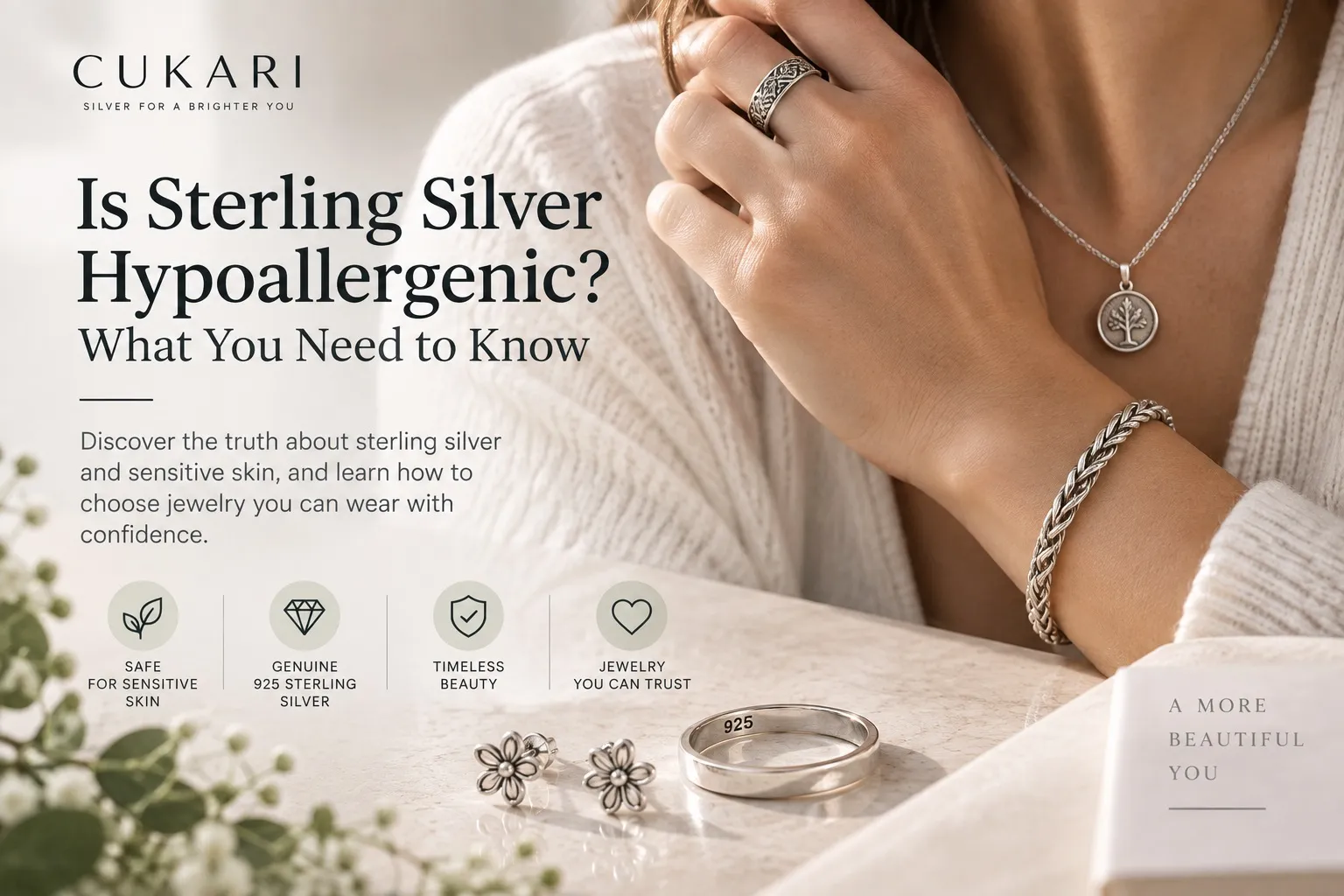
If you have ever worn a pair of earrings or a ring that left your skin itchy, red, or uncomfortable, you probably know how quickly a simple jewelry purchase can turn into a material question. Sterling silver is often recommended as a better choice for sensitive skin, but there is an important distinction between being generally well tolerated and being completely allergy-proof.
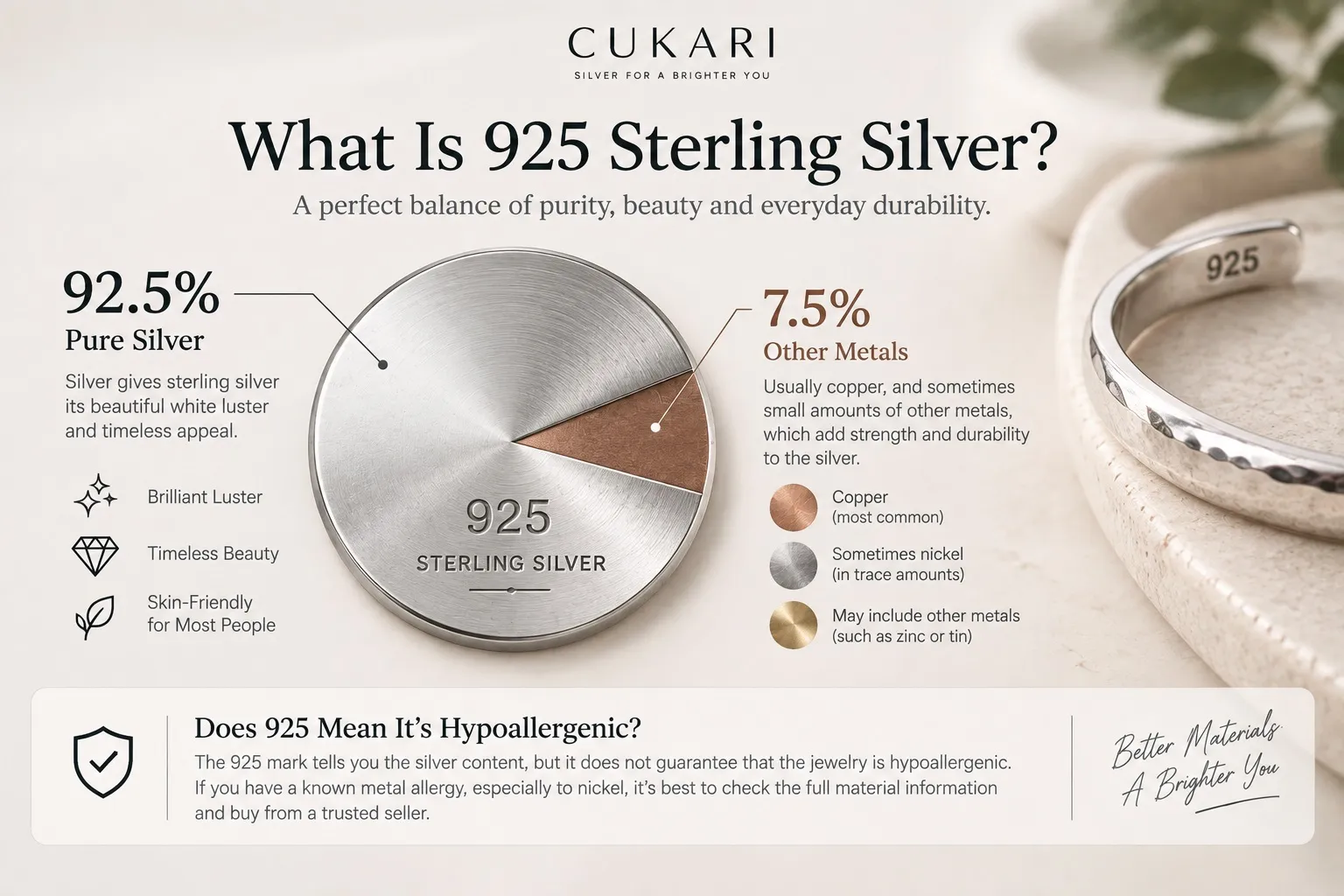
Sterling silver contains 92.5% silver, with the remaining 7.5% made up of other metals that give the material enough strength for everyday jewelry. The 925 mark tells you about the silver content, but it does not tell you everything about the alloy or every metal component that may touch your skin.
For many people, genuine sterling silver is a comfortable choice for rings, bracelets, necklaces, and earrings. Someone with a known nickel allergy, however, should look a little further than the number stamped on the jewelry. The composition of the alloy, the presence of plating, and even small components such as earring posts or clasps can all be relevant.
This guide looks at what “hypoallergenic” actually means, why sterling silver is generally considered a skin-friendly jewelry material, what can cause irritation, and what to look for if your skin does not get along with certain metals.
Table of Contents
- What Does “Hypoallergenic” Mean for Jewelry?
- Is Sterling Silver Hypoallergenic?
- Can Sterling Silver Cause a Skin Reaction?
- Why Some “Silver” Jewelry Causes Problems
- Does a 925 Stamp Mean Jewelry Is Hypoallergenic?
- What About Silver-Plated Jewelry?
- How to Choose Sterling Silver for Sensitive Skin
- How to Reduce Skin Irritation While Wearing Jewelry
- What to Do If Sterling Silver Irritates Your Skin
- Common Misunderstandings About Sterling Silver and Sensitive Skin
- FAQ
- What Matters More Than the Word “Hypoallergenic”?
What Does “Hypoallergenic” Mean for Jewelry?
“Hypoallergenic” is best understood as less likely to cause an allergic reaction, rather than “guaranteed not to cause an allergy.” That distinction is easy to lose in jewelry marketing, where the word is sometimes used as though it were a certification that makes a piece suitable for everyone.
It is particularly important when discussing metal allergies. Nickel is one of the most common causes of allergic contact dermatitis, and jewelry is a familiar source of exposure. Earrings, rings, necklaces, bracelets, and watch components can all cause problems when they contain a metal that a person is sensitive to.
There is another complication: skin can become irritated by jewelry without there being a true metal allergy at all. Friction, trapped soap and water, sweat, dirt, and other materials around the jewelry can produce irritation that looks similar to an allergic reaction.
So when a jewelry listing says “hypoallergenic,” it is better to treat that as useful information rather than an absolute promise.
Is Sterling Silver Hypoallergenic?
Genuine sterling silver is generally considered a good choice for many people with sensitive skin, but it should not automatically be described as completely hypoallergenic.
The reason is simple once you look at what sterling silver actually is. Sterling silver contains 92.5% pure silver, while the remaining 7.5% consists of other metals used to give the material greater strength and durability. The FTC recognizes “silver,” “sterling,” and “sterling silver” as terms for products containing 92.5% pure silver, with 925 indicating 925 parts silver per thousand.
That added alloy is necessary for practical reasons. Pure silver is relatively soft, whereas jewelry needs to tolerate bending, handling, scratching, and everyday wear. Sterling silver provides a useful balance between high silver content and the physical strength needed for jewelry.
The part that matters for someone with a metal allergy is that 92.5% silver does not tell you exactly what makes up the remaining 7.5%.
Why 925 Sterling Silver Is Not the Same as Pure Silver
The number 925 refers to purity, not allergy resistance.
Fine silver is generally around 99.9% silver, while sterling silver contains 92.5% silver. The higher purity of fine silver makes it softer, which is one reason sterling silver is more commonly used for jewelry that needs to withstand regular wear.
This is also why a higher silver percentage does not automatically make one material “better.” A delicate piece that is rarely worn has different requirements from a bracelet that moves against the wrist every day or a ring that is exposed to constant contact with other surfaces.
If you want to explore the difference in more detail, see our guide to Sterling Silver vs. Pure Silver: What Is the Difference?.
What Metals Are Used in Sterling Silver?
Copper is commonly used to alloy sterling silver because it increases strength and makes the material more practical to work with. DermNet describes sterling silver as 92.5% silver alloyed with copper, while also noting that some sterling silver may contain small amounts of other metals, meaning traces of nickel can be present in certain pieces.
This is an important distinction when shopping for jewelry for sensitive skin. The 925 mark tells you the silver content; it does not provide a complete chemical analysis of the jewelry.
That does not mean that sterling silver is unsuitable for people with sensitive skin. Quite the opposite: sterling silver is widely used as a jewelry material for people who want to avoid many of the cheaper base metals found in costume jewelry. The point is simply that someone with a known allergy should look for more specific material information instead of assuming that every 925 item is identical.
Can Sterling Silver Cause a Skin Reaction?
It can, but a reaction to jewelry does not automatically mean that the person is allergic to silver.
A rash beneath a ring, bracelet, necklace, or pair of earrings can have several possible causes. A genuine metal allergy is one possibility, but irritation from moisture, friction, soap, dirt, or another component of the jewelry can produce a similar result. DermNet specifically distinguishes allergic contact dermatitis from irritant reactions caused by things such as friction, surface particles, soap, and water trapped underneath jewelry.
That distinction is worth keeping in mind because people often notice redness or itching and immediately conclude that “silver does not agree with my skin.” The skin reaction alone cannot tell you which material or condition is responsible.
Why Nickel Matters
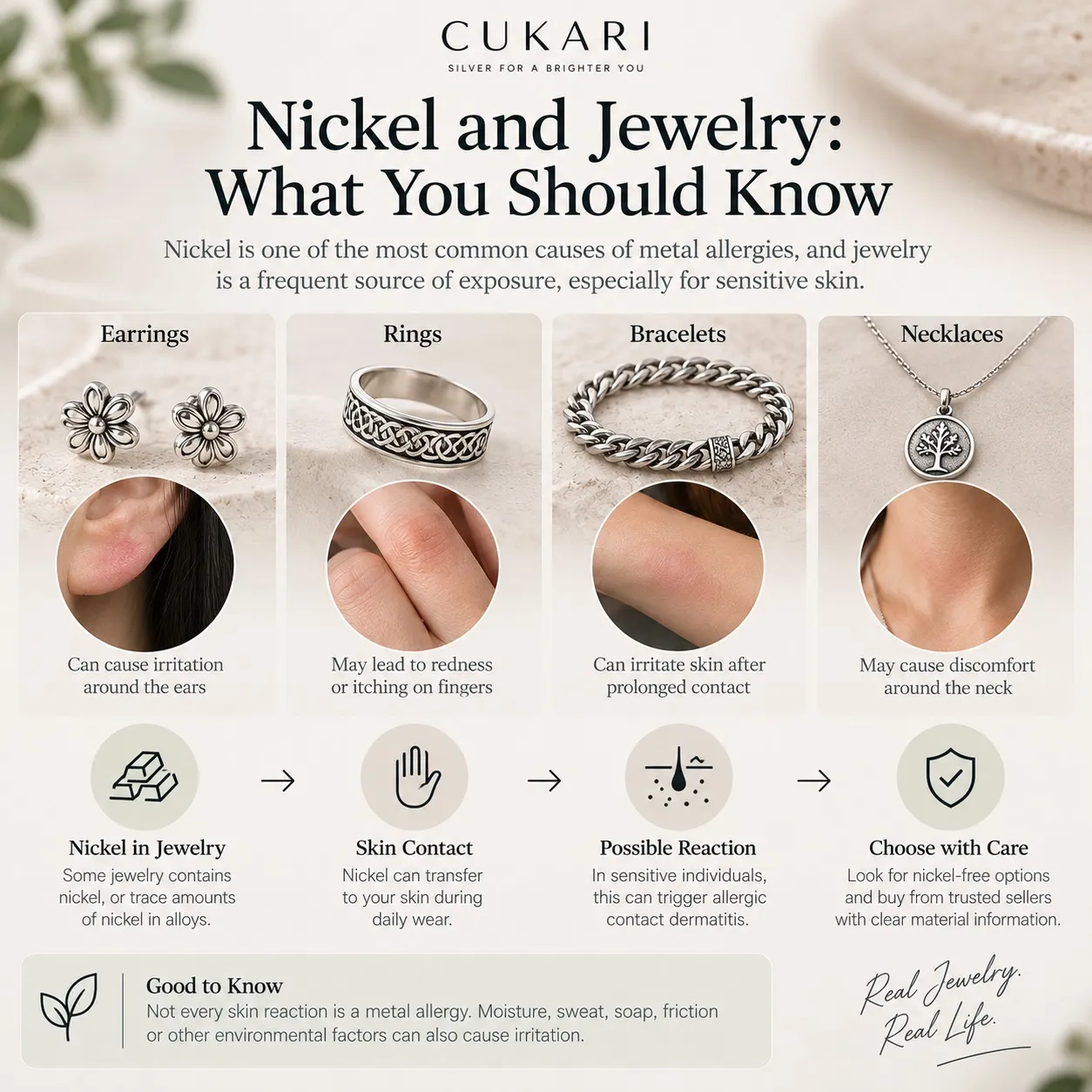
Nickel is one of the most common causes of allergic contact dermatitis, and jewelry is a well-known source of exposure. The American Academy of Dermatology specifically lists earrings, earring backs, rings, necklaces, and bracelets among the types of jewelry that can trigger symptoms in people with nickel allergy.
For someone who already knows they have a nickel allergy, this changes the way jewelry should be chosen. Instead of looking only for the word “silver,” it makes more sense to check whether the product is specifically described as nickel-free and whether the seller can provide reliable information about the materials used.
DermNet also notes that jewelry allergy is most often associated with nickel or cobalt and that nickel can sometimes be present as a trace element in precious-metal alloys.
Not Every Reaction Is a Metal Allergy
This is one of the most useful distinctions to understand.
Suppose you wear a ring all day, wash your hands several times, apply hand cream, and never remove the ring. Moisture and residue can remain beneath it for hours. If the ring also fits tightly and rubs against the skin, irritation becomes much more plausible.
That does not prove that you are allergic to the metal.
The American Academy of Dermatology similarly recommends paying attention to what touches the affected area and notes that soap and water trapped beneath a ring can contribute to irritation.
An allergic reaction tends to involve symptoms such as itching, redness, rash, dryness, or blistering. If the same jewelry repeatedly produces these symptoms, especially when the problem disappears after you stop wearing it, it is worth discussing the reaction with a dermatologist rather than trying to diagnose the exact metal yourself.
Why Some “Silver” Jewelry Causes Problems
The phrase “silver jewelry” covers more than one type of material.
A piece may be sterling silver, fine silver, silver-plated, or another base metal with a silver-colored finish. Two pieces can look almost identical in a photograph while having very different material compositions.
This is particularly important with silver-plated jewelry. A silver-plated piece has a layer of silver applied over a base metal, whereas sterling silver itself is a silver alloy. The FTC makes this distinction clearly in its consumer guidance on silver jewelry.
The base metal matters because it can become exposed as the plating wears down, particularly around edges, clasps, ring interiors, and other areas that experience frequent friction.
For someone with sensitive skin, this is one reason that knowing the construction of the jewelry can be more useful than simply knowing that its surface looks silver.
You can read more about this difference in Sterling Silver vs. Silver-Plated Jewelry: How Can You Tell the Difference?.
Does a 925 Stamp Mean Jewelry Is Hypoallergenic?
No. 925 and hypoallergenic describe different things.
A 925 mark indicates the intended silver purity: 925 parts per thousand silver. “Hypoallergenic” is a description suggesting that a product is less likely to cause an allergic reaction. One does not prove the other.
This is an easy detail to overlook when shopping online. A customer may see “S925” stamped on a ring and assume that it also means nickel-free, but the stamp does not provide that level of information.
If you are buying jewelry for someone with a known nickel allergy, ask about the alloy and the other components that will touch the skin. For earrings, that includes the posts and backs. For bracelets and necklaces, clasps and connecting components deserve attention as well.
If you want to learn how to assess whether a 925 bracelet is actually sterling silver, our guide How to Tell If a 925 Sterling Silver Bracelet Is Real: A Practical Guide covers the 925 mark, product descriptions, construction, testing, and other signs worth checking.
What About Silver-Plated Jewelry?
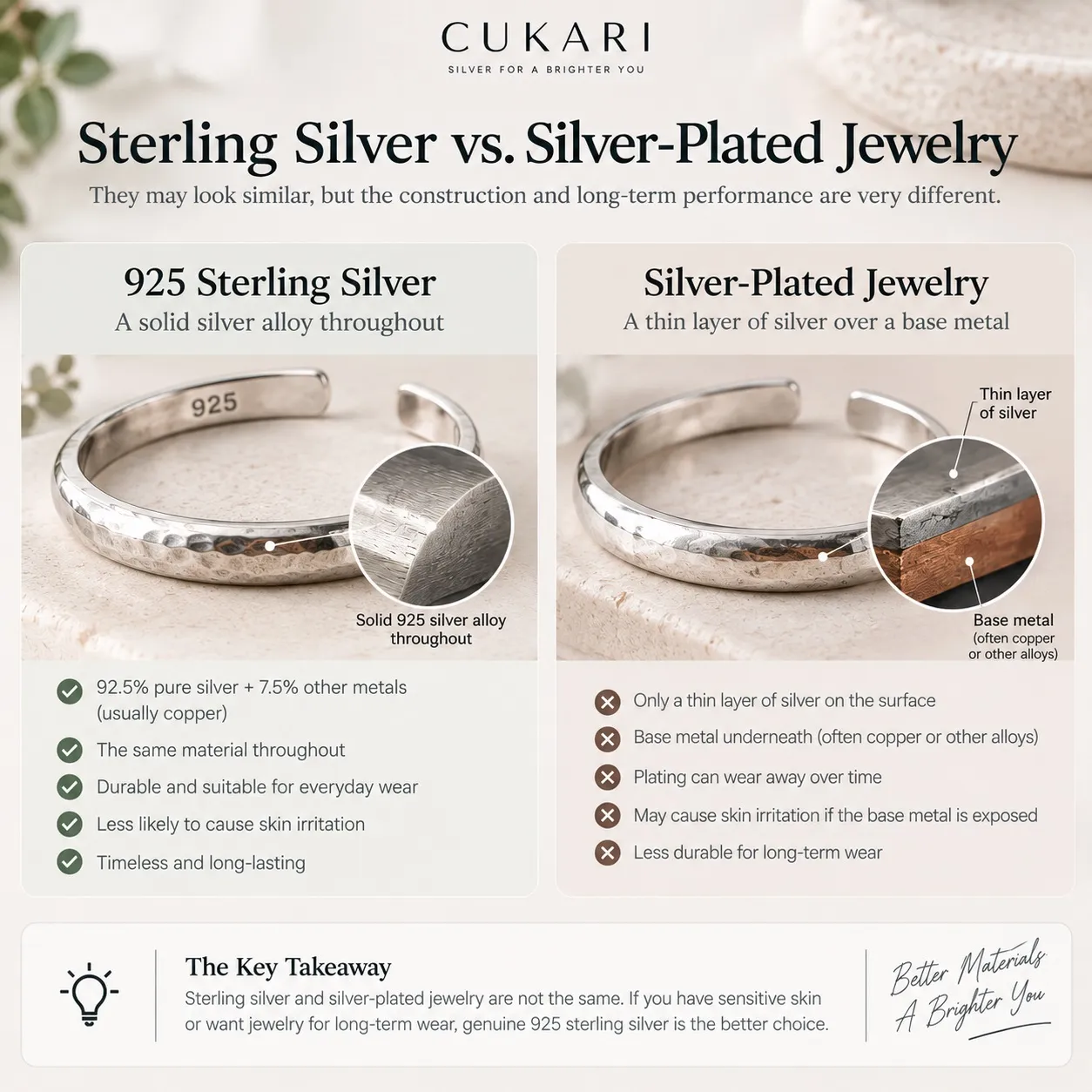
Silver-plated jewelry is not automatically bad jewelry. It simply needs to be understood for what it is.
The silver is a surface layer rather than the main material throughout the piece. The layer can make a base-metal item look attractive and give it the appearance of silver, but the underlying metal remains part of the jewelry’s construction.
For someone concerned about skin sensitivity, that distinction becomes more important if the plating starts to wear. A ring interior, bracelet edge, clasp, or earring component can experience considerable friction over time, and once the surface layer becomes damaged or worn, the underlying material may have more contact with the skin.
That does not mean every plated item will cause an allergic reaction, just as genuine sterling silver cannot guarantee that nobody will react to it. It means the two materials should not be treated as interchangeable when you are trying to choose jewelry for sensitive skin.
How to Choose Sterling Silver for Sensitive Skin
If your skin tends to react to jewelry, I would start with material transparency rather than with the style or price.
Look for a clear description such as Plata de ley 925, rather than a vague phrase such as “silver tone.” If you already have a diagnosed nickel allergy, look for specific information about nickel content rather than assuming that the 925 mark answers that question.
It is also worth checking whether the entire piece is sterling silver or whether certain parts are plated or made from another material. The decorative part of an earring may be sterling silver while the post or backing is made from something else. Similarly, a bracelet may have a sterling silver body but use a clasp made from a different metal.
This becomes particularly relevant with earrings because the post and backing sit directly against the skin.
Rings and Bracelets
Rings and bracelets are exposed to a surprising amount of everyday abuse. They encounter water, soap, sweat, hand cream, perfume, friction, and repeated movement, often without the wearer thinking much about it.
Fit matters, too. A ring that is too tight can hold moisture against the skin, while a bracelet that constantly rubs the same area can cause irritation even when the material itself is well tolerated.
If you are shopping specifically for women’s bracelets, Cukari’s Pulseras de plata de ley para mujer collection includes different chain structures and styles. For a more structured look, the Women’s Sterling Silver Bangles collection offers closed and open designs.
The important point is not that one style is automatically better for sensitive skin. A comfortable fit, smooth finishing, and clear material information matter more.
collares
Necklaces can remain in contact with the skin for many hours, particularly during warm weather. Sweat, perfume, lotion, and other products can accumulate around the chain or pendant and sometimes contribute to irritation.
If a necklace repeatedly causes discomfort around the neck, consider both the metal and the conditions in which you are wearing it. A reaction does not necessarily mean that the silver itself is the problem.
For everyday styles, you can browse Cukari’s Women’s Sterling Silver Necklaces collection and check the material information for each individual design.
Pendientes
Earrings deserve particular attention if you have sensitive skin because the post, hook, or backing may remain in direct contact with the skin for most of the day.
The American Academy of Dermatology identifies earrings and earring backs as common sources of nickel exposure for people with nickel allergy.
For that reason, do not look only at the decorative face of the earring. Check the parts that actually pass through or rest against the ear.
Cukari’s Pendientes de plata de ley y Pendientes de plata de ley con forma de gota collections are useful starting points, but the material details of the individual design are still the information that matters when you have a specific allergy concern.
How to Reduce Skin Irritation While Wearing Jewelry
Even when the metal is suitable for you, a few everyday habits can make jewelry much more comfortable to wear.
Keep the jewelry clean and make sure the skin underneath it is dry. If you wash your hands while wearing a ring, for example, take a moment to dry underneath the ring as well rather than leaving moisture trapped there.
The same applies to bracelets and necklaces after exercise or in hot weather. Sweat itself is not proof that a reaction will occur, but prolonged moisture combined with friction and residue can make irritated skin more likely.
It is also sensible to remove jewelry before swimming, showering, cleaning, or using products that may leave residue on the metal or skin. This is good jewelry care as well as a sensible way to reduce unnecessary skin exposure.
If you regularly experience irritation from a particular piece, pay attention to whether the problem changes when you wear it for shorter periods, keep the area dry, or stop using lotions and fragrances underneath it. Those observations can help you and your dermatologist work out what is actually causing the problem.
What to Do If Sterling Silver Irritates Your Skin
If a piece of jewelry causes persistent itching, redness, swelling, blistering, or a rash, the safest approach is to stop wearing the piece rather than repeatedly testing your skin.
If the irritation disappears after removing the jewelry and returns when you wear it again, that pattern is worth mentioning to a healthcare professional. It still does not identify the exact metal by itself, but it can be useful when investigating contact dermatitis.
The American Academy of Dermatology recommends avoiding the suspected jewelry when a rash develops and consulting a dermatologist when the problem persists, repeatedly returns, blisters, or becomes infected. Patch testing may be used to identify a specific allergen when a metal allergy is suspected.
This is particularly important if you already know that you have a nickel allergy. In that situation, avoiding nickel-containing jewelry is much more useful than simply changing from one silver-colored product to another.
Common Misunderstandings About Sterling Silver and Sensitive Skin
“925 means the jewelry is hypoallergenic.”
Not quite. The 925 mark tells you about silver content. It does not, by itself, guarantee that the jewelry is nickel-free or that every wearer will tolerate it.
“If my skin turns green, I am allergic to silver.”
A green mark and an allergic reaction are not the same thing. Green discoloration can be related to metals, moisture, residue, or the construction of the jewelry, while an allergic reaction involves an immune response and commonly produces symptoms such as itching and dermatitis.
Our guide on why sterling silver can turn green explains the difference in more detail.
“Hypoallergenic means that I cannot react to the jewelry.”
No. The term means that the jewelry is considered less likely to cause an allergic reaction. It is not an absolute guarantee for every person.
“Silver-plated jewelry is basically the same as sterling silver.”
It is not. Sterling silver contains 92.5% silver, while silver-plated jewelry has a layer of silver over another metal.
“If one sterling silver piece irritates me, I cannot wear sterling silver at all.”
Not necessarily. Different pieces can have different alloy compositions, coatings, solder, clasps, posts, and other components. If you have a known allergy, identifying the actual trigger is more useful than assuming that every silver item will behave the same way.
FAQ
Is 925 sterling silver good for sensitive skin?
For many people, yes. Sterling silver is widely used in jewelry and is generally well tolerated. If you have a known metal allergy, however, you should check the specific material composition rather than assuming that every 925 piece will suit you.
Is sterling silver nickel-free?
You should not assume that every sterling silver item is nickel-free simply because it is marked 925. Sterling silver is defined by its silver content, while the composition of the remaining alloy and other jewelry components can vary. DermNet notes that traces of nickel may occur in some sterling silver.
If you have a diagnosed nickel allergy, look for jewelry specifically identified as nickel-free and ask the seller when the material information is unclear.
Can sterling silver cause itchy ears?
It can, but the cause may be nickel, another metal, friction, moisture, or another component of the earring. Because earrings and their backs can remain in contact with the skin for long periods, they are a common source of jewelry-related reactions.
Is pure silver better than sterling silver for sensitive skin?
Not automatically. Fine silver has a higher silver content, but it is also softer and less practical for many everyday jewelry applications. If you have a metal allergy, the composition of the particular piece matters more than simply choosing the highest silver percentage.
What should I do if sterling silver gives me a rash?
Stop wearing the jewelry and see whether the reaction improves. If the rash persists, repeatedly returns, blisters, or becomes infected, seek medical advice. A dermatologist can help determine whether the cause is nickel or another allergen, or whether the irritation is coming from something else.
What Matters More Than the Word “Hypoallergenic”?
When buying jewelry for sensitive skin, “hypoallergenic” can be a useful starting point, but it should not be the only thing you look at.
A better approach is to find out what the jewelry is actually made from. The 925 mark tells you that the material is intended to contain 92.5% silver. A nickel-free statement gives you more specific information if nickel is a concern. Details about plating, clasps, earring posts, backs, and other components can tell you even more about what will eventually be touching your skin.
For most people, genuine 925 sterling silver is a practical material for everyday jewelry because it combines a high silver content with enough strength for regular wear. That does not make it universally allergy-proof, but it does explain why sterling silver has remained one of the most widely used silver materials in jewelry.
If you have sensitive skin, the safest shopping habit is therefore not to look for one magic word on a product page. Look for clear material information, buy from a seller willing to answer specific questions, and pay attention to the parts of the jewelry that actually touch your skin.
That is a much more useful way to think about hypoallergenic jewelry than simply assuming that every piece marked “925” will work for everyone.