
How to Tell if Silver Jewelry Is Real: 925, Hallmarks, Tests and Common Mistakes
Buying silver jewelry should not require you to become a metals expert, but it does help to understand what you are actually looking at. A small number stamped inside a ring, a description that says “sterling silver,” or a bright white surface can all provide useful clues, yet none of them tells the whole story on its own.
The confusion usually begins because silver jewelry can take many different forms. A genuine sterling silver ring can become dark with tarnish, an oxidized silver bracelet may deliberately have a blackened surface, and silver-plated jewelry can look almost indistinguishable from sterling silver when it is new. At the same time, inexpensive metals can be polished and finished to resemble silver surprisingly well.
So how can you tell whether a piece is really silver?
The most reliable approach is not to rely on one dramatic home test. Instead, look at the material description, check the marks, examine how the jewelry has been made and worn, and use simple tests only as supporting evidence. If the piece is valuable enough that you need certainty, professional metal testing is the sensible final step.
Table of Contents
- What Does “Real Silver” Actually Mean?
- What Does a 925 Mark Mean?
- How to Read Silver Marks and Hallmarks
- Sterling Silver vs. Silver-Plated Jewelry
- Can You Tell Real Silver by Looking at It?
- Look at the Areas That Wear First
- Does the Magnet Test Work?
- Can Tarnish Prove That Silver Is Real?
- What About the Ice Test?
- Should You Use an Acid Test?
- When Professional Testing Makes Sense
- How to Check Silver Jewelry Before Buying Online
- Common Mistakes When Testing Silver Jewelry
- Frequently Asked Questions
- What Matters Most When Buying Silver Jewelry?
What Does “Real Silver” Actually Mean?
Before trying to test a piece of jewelry, it helps to decide what you mean by “real silver.” The phrase sounds straightforward, but it can describe several different situations.
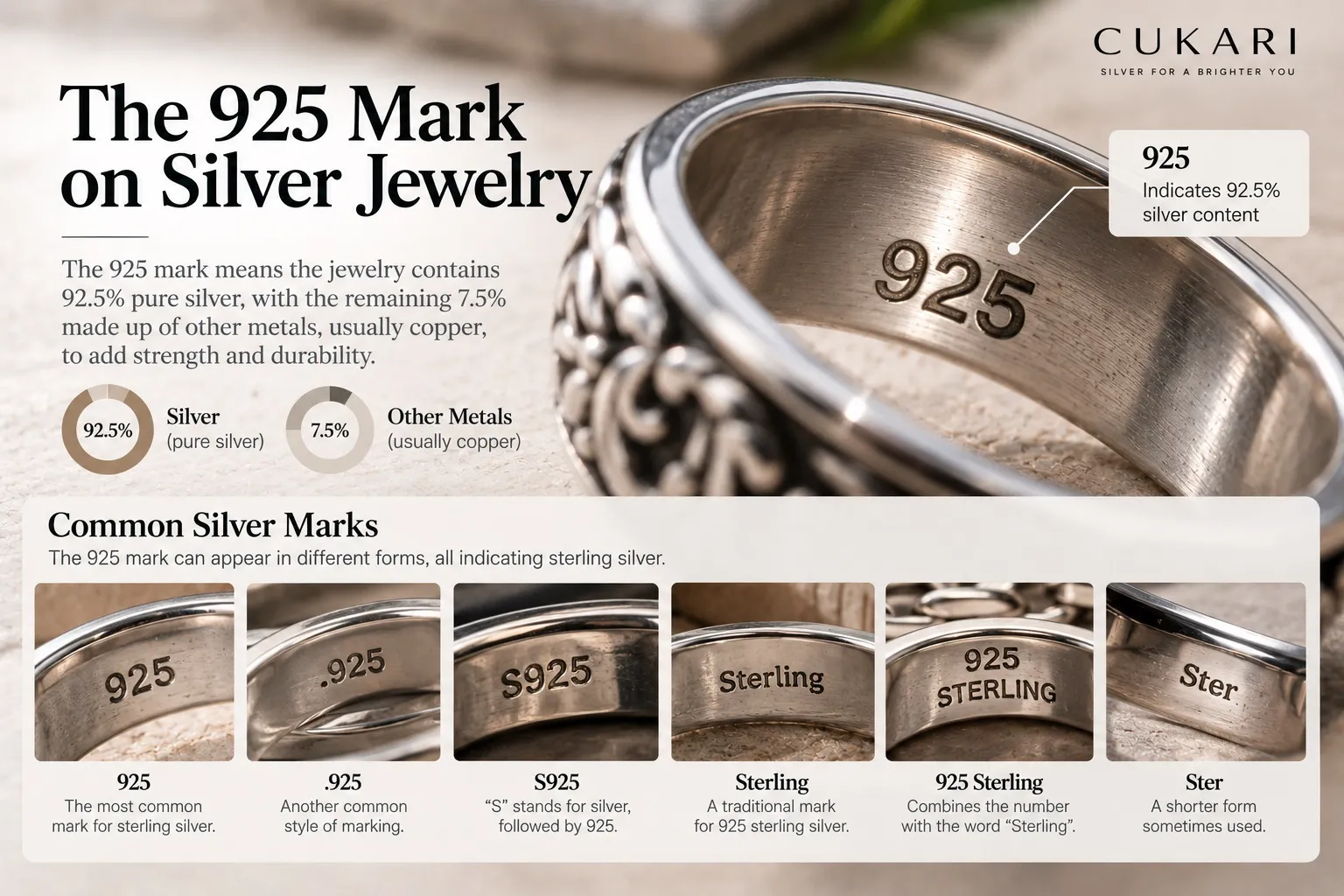
When people are shopping for everyday silver jewelry, they are often looking for 925 sterling silver. The 925 standard means that 925 parts out of every 1,000 parts of the alloy are silver, giving the material a silver content of 92.5%. The remaining 7.5% is made up of other metals, commonly copper, which are added because pure silver is relatively soft and not particularly practical for jewelry that has to withstand regular wear.
The distinction becomes important when you encounter the term silver-plated.
Silver-plated jewelry does contain silver, but only as a layer applied over another metal. The silver-colored surface may look convincing when the piece is new, yet the material beneath that surface is not sterling silver. The Federal Trade Commission distinguishes silver-plated products from jewelry made of sterling silver and requires the nature of the coating to be represented accurately.
There are also other legitimate silver standards. Fine silver, for example, is commonly marked 999, indicating 99.9% silver. Older jewelry and pieces made for different markets may use other recognized fineness marks as well.
That is why “real silver” is not really a question of whether a piece is simply silver or fake. A better question is:
What silver standard is the jewelry made to, and does the physical piece match that description?
If you are still getting familiar with silver terminology, our guide to what 925 means on silver jewelry is a useful place to start.
What Does a 925 Mark Mean?
The small 925 you find inside a ring, on the back of a pendant, near a bracelet clasp or on another discreet part of a piece is one of the most familiar marks associated with sterling silver.
Its meaning is relatively simple. 925 means 925 parts per thousand silver, or 92.5% silver.
You may encounter slightly different versions of the same designation, including:
- 925
- .925
- 925 Sterling
- Sterling
- Ster
- S925
The exact marking conventions vary between manufacturers and countries, so the appearance of the stamp can differ from one piece to another.
It is worth making one distinction here because it is easy to overlook. A 925 mark is a fineness indication, not a magical guarantee that every piece carrying the number has been independently tested by a laboratory. Marks can be copied or misused, particularly on poorly documented or counterfeit jewelry. A sensible buyer therefore treats the mark as important evidence, but considers it alongside the seller, product description, construction and, when necessary, an actual metal test.
In other words, finding “925” is a good reason to investigate further, not a reason to stop looking.
For everyday jewelry from an established seller, however, a clear material description combined with the appropriate marking gives you much more useful information than trying to judge authenticity from appearance alone.
How to Read Silver Marks and Hallmarks
People often use the words hallmark and stamp as though they mean exactly the same thing. Technically, they do not.
A fineness mark tells you about the precious-metal content. A maker’s or sponsor’s mark can identify the company or person responsible for the piece or the mark, while a formal hallmark in certain countries represents a more comprehensive system of independent testing and marking.
Fineness marks
A number such as 925 expresses the silver content in parts per thousand. A 925 mark therefore represents 925/1000 silver.
Other numbers can also be legitimate. A piece marked 999 is fine silver, while some historical and regional standards use different fineness levels. The absence of “925” does not automatically make a piece counterfeit.
Maker’s marks
A maker’s mark can provide another useful piece of information, particularly when you are examining older or higher-value jewelry. If you can identify the maker and compare the mark with reliable references, you may be able to learn more about when and where the piece was made.
Formal hallmarks
Formal hallmarking systems go further than a simple 925 stamp. The UK is a good example: a full hallmark can contain a sponsor’s mark, a fineness mark and an assay office mark, with the hallmark indicating that the precious-metal content has been independently tested within the relevant system.
This is particularly useful when buying vintage jewelry. Rather than seeing an unfamiliar symbol and assuming that it means the piece is fake, it is better to identify the marking system that applies to the country and period in which the jewelry was made.
Sterling Silver vs. Silver-Plated Jewelry
If you only learn one distinction from this article, make it this one.
Sterling silver and silver-plated jewelry are not constructed in the same way.
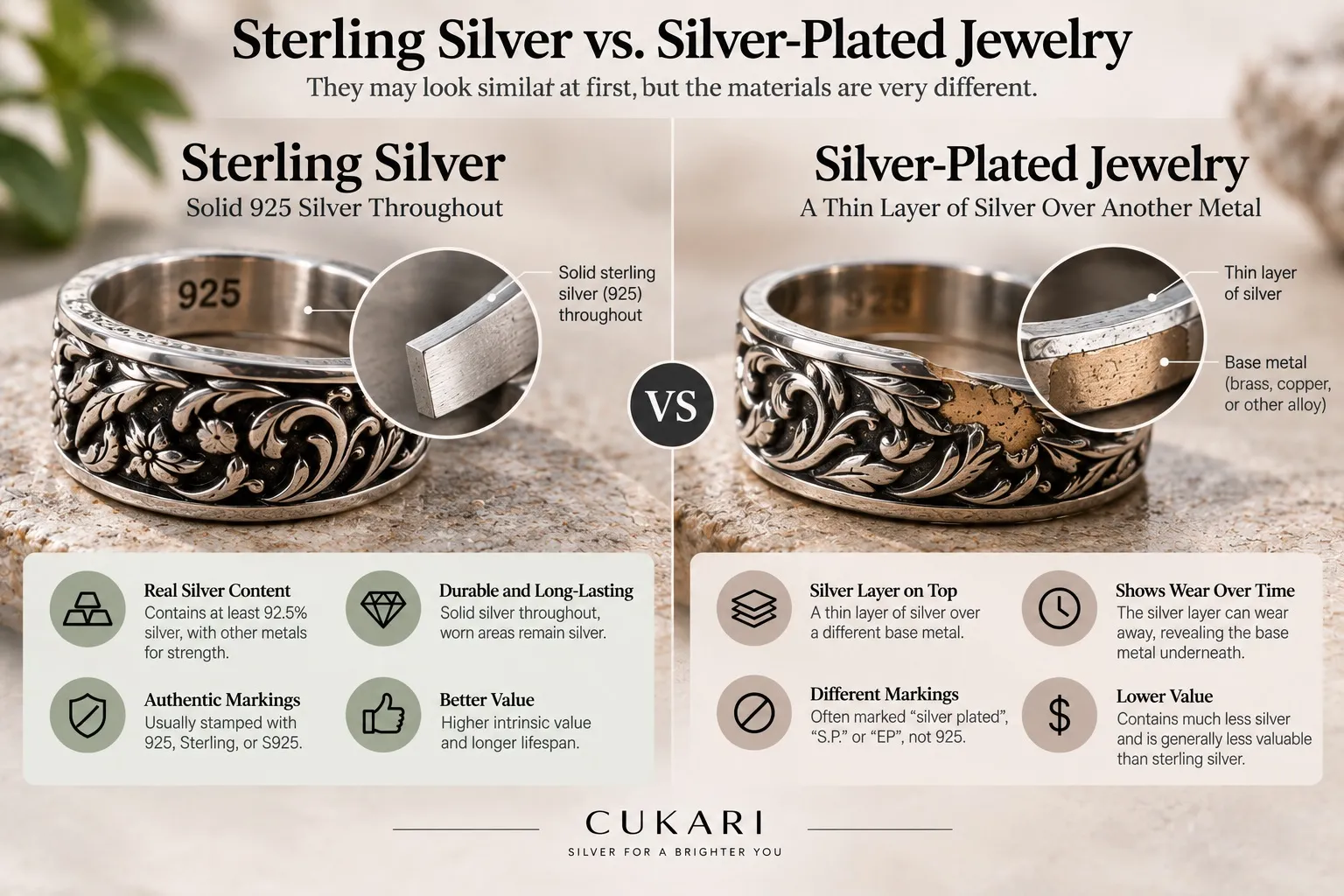
Sterling silver is a silver alloy throughout the material. Silver-plated jewelry has a layer of silver applied over a different base metal.
When both pieces are freshly polished, that difference can be almost impossible to see. A photograph can make the problem even harder because lighting, editing and reflections can hide subtle differences in surface color and texture.
Wear often makes the distinction easier to understand.
Consider a bracelet that has been worn regularly for several years. The underside of the links may rub against the wrist, the edges may contact clothing and the clasp may experience repeated friction. If a silver-plated surface becomes thin or worn through, the metal underneath can eventually become visible.
A sterling silver bracelet can certainly scratch, dent or change color, but the underlying material remains sterling silver. There is no separate base metal waiting underneath a thin silver coating.
This is also why the words used in a product description matter. “Sterling silver,” “silver-plated,” “silver tone” and “silver color” describe very different things.
Our detailed guide to sterling silver vs. silver-plated jewelry explains the difference in construction, durability and surface wear in more detail.
Can You Tell Real Silver by Looking at It?
Sometimes you can spot a problem by looking closely, but appearance alone is not a reliable authentication method.
Genuine sterling silver does not always look the same. Freshly polished silver can be bright and highly reflective, while older silver may have a softer appearance. Tarnish can turn the surface yellowish, gray, brown or nearly black, and oxidized silver is intentionally given a darker finish that can make parts of the jewelry look almost black.
None of those appearances automatically means that the jewelry is fake.
Instead of judging the overall color, examine the details. Look inside the ring, around the clasp, underneath a bracelet, behind a pendant or along the edges of a piece. These less visible areas often preserve information that the polished front surface does not.
A small magnifying glass or jewelry loupe can be surprisingly useful here. You may be able to find a 925 mark, a maker’s mark, evidence of plating, or a difference in surface texture that is difficult to see with the naked eye.
The important point is that visual inspection is best used to find clues and inconsistencies, rather than to produce a simple yes-or-no answer.
Look at the Areas That Wear First
Jewelry rarely wears evenly.
A ring receives friction every time it moves against another object. A bracelet repeatedly contacts clothing, desks, skin and other jewelry. Necklace chains rub against themselves and against pendants, while earrings experience repeated contact around the post, clasp and backing.
Those high-contact areas can sometimes tell you more about a piece than its most polished surface.
Suppose a bracelet is described as sterling silver, but a noticeably different-colored metal begins to appear where the links have been heavily rubbed. That is worth investigating because sterling silver should not reveal a separate base metal underneath simply because its surface has become scratched.
There are other explanations for changes in appearance, however. Genuine sterling silver can develop scratches and dents, and oxidized silver can gradually become brighter on raised surfaces as friction removes some of the darkened finish.
The useful question is therefore not simply whether a piece has changed with wear. Look at what kind of change has occurred and where it appears.
This is especially helpful when you are trying to distinguish solid sterling silver from a plated surface.
Does the Magnet Test Work?
The magnet test is popular because it is quick, inexpensive and easy to perform. There is some truth behind it, but it is often given more authority than it deserves.
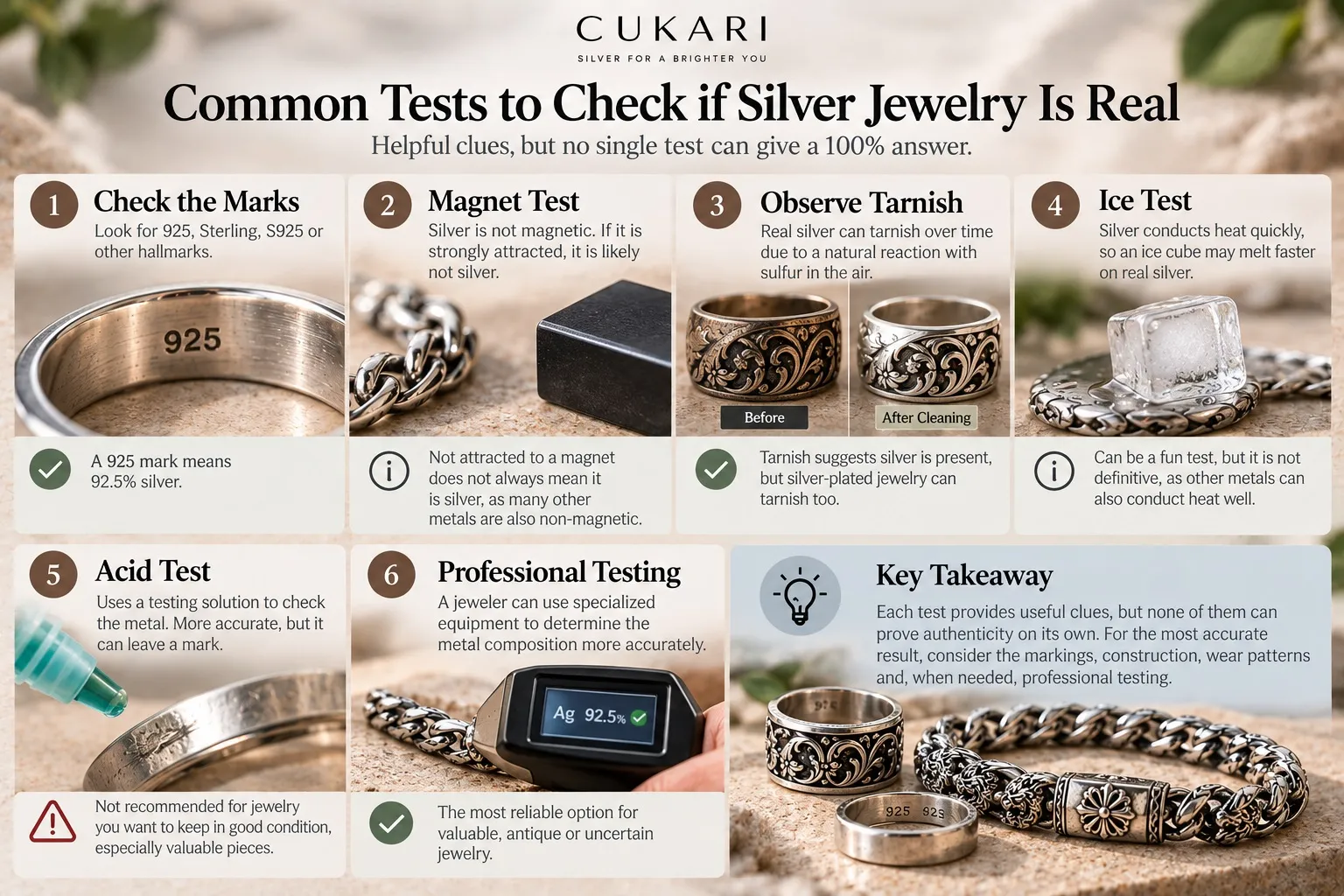
Silver is not strongly attracted to an ordinary magnet. If the main body of a supposedly sterling silver piece is strongly pulled toward a magnet, that is a reason to question the material.
The reverse conclusion does not work.
A piece that does not attract a magnet is not automatically silver.
Many other metals are also non-magnetic, including some materials that may be used as the base of silver-colored or silver-plated jewelry. A negative magnet test therefore cannot distinguish sterling silver from every possible alternative.
Jewelry construction can make the test even more confusing. Clasps may contain springs or other small components made from different metals, so testing only the clasp may tell you very little about the main body of a necklace or bracelet.
Use the magnet as a quick screening tool if you like, but treat it as one small piece of evidence rather than an authenticity certificate.
Can Tarnish Prove That Silver Is Real?
Tarnish is one of the most misunderstood clues in silver jewelry.
Yes, sterling silver can tarnish. Exposure to substances in the surrounding environment can gradually change the surface, and a piece may become darker or lose some of its original brightness.
But tarnish does not prove that a piece is solid sterling silver.
The reason is simple: silver-plated jewelry has real silver on its surface, so the silver layer can tarnish as well. A darkened surface therefore tells you that silver may be present, but it cannot tell you how much silver is underneath it.
The opposite assumption can be misleading too. Jewelry that remains bright does not automatically mean that it is fake. Polishing, storage conditions, surface treatments and the way the jewelry is worn can all affect how quickly visible tarnish develops.
If you have noticed that your own silver jewelry has become black or dark gray, see our guide on why sterling silver jewelry turns black. It explains the difference between ordinary tarnish and other forms of discoloration.
What About the Ice Test?
You may have seen videos showing an ice cube melting quickly on silver and presenting the result as proof that the metal is genuine.
There is a real physical principle behind the experiment. Silver conducts heat very efficiently, so a piece of silver can transfer heat to an ice cube rapidly.
The problem is that jewelry is not a controlled laboratory sample.
A small ring, a thin chain and a large flat bracelet have different masses, shapes and surface areas. The temperature of the jewelry and the surrounding environment also affect the result. Other metals can conduct heat reasonably well, which makes timing the melting process an unreliable way to identify 925 silver.
The ice test can be a fun demonstration of thermal conductivity, but it should not be treated as a dependable authentication method.
Should You Use an Acid Test?
Acid testing can provide more useful information than a magnet or ice test because the testing solution reacts with the metal being examined. Even so, it is not the first method I would recommend for jewelry that you want to keep in good condition.
Depending on the testing method, the process can involve scratching or filing a small area before applying the solution. That means the test itself can leave a mark.
There is another problem when plated jewelry is involved. If the test is performed only on the silver-colored surface, the result may reflect the silver coating rather than the base metal underneath it.
For a low-value piece that you do not mind marking, a properly performed test may have a place. For an antique ring, an inherited necklace, a valuable bracelet or a piece with sentimental importance, professional testing is a much more sensible option.
When Professional Testing Makes Sense
Most inexpensive silver jewelry does not need laboratory analysis. If you have bought a clearly described 925 bracelet from an established seller and the markings and construction are consistent with the description, there may be little reason to go further.
The situation changes when the value or uncertainty increases.
Professional testing makes particular sense when a piece is valuable, antique, inherited, difficult to identify, being prepared for resale, or described as a specific precious-metal standard that you need to verify with confidence.
A professional jeweler or testing service can examine the markings, construction and metal composition using methods that are more informative than the simple tests available at home. Formal assay systems can provide an additional level of verification in countries where hallmarking is required or commonly used.
In other words, home testing is useful for curiosity and preliminary screening. When the answer matters financially, professional testing is the better tool.
How to Check Silver Jewelry Before Buying Online
Buying online changes the process because you cannot turn the jewelry over in your hands before paying for it. That makes the information provided by the seller much more important.
Start with the material description, not the photograph.
A product described as “silver tone,” “silver color” or “silver finish” should not be treated as though it were automatically sterling silver. If the jewelry is supposed to be 925 sterling silver, the material should be stated clearly.
Next, look for information about the brand or seller, the return policy and the way the product is described. A trustworthy listing should not need vague wording to create the impression that an inexpensive metal is sterling silver.
Photographs of hallmarks can also be useful, particularly when buying vintage jewelry. If a seller claims that a ring or bracelet is 925 sterling silver but avoids showing the relevant marking or provides contradictory material information, that inconsistency deserves attention.
Price can provide context, but it is not an authenticity test. Genuine sterling silver can be sold at many different prices depending on weight, craftsmanship, design, gemstones, brand and production method. Conversely, an expensive piece is not automatically genuine simply because the price looks impressive.
The strongest approach is to consider several details together:
material description + markings + seller information + construction + return protection.
That combination tells you considerably more than any single home test.
Common Mistakes When Testing Silver Jewelry
Mistake 1: Treating a 925 stamp as absolute proof
A 925 mark is important because it represents a claimed silver fineness, but a stamp can be copied or misused. When something about the jewelry seems inconsistent with the description, the mark should be one part of your investigation rather than the entire investigation.
Mistake 2: Assuming non-magnetic means genuine
Silver is not strongly magnetic, but neither are many other metals. A magnet can help rule out certain possibilities, but it cannot establish that a non-magnetic piece is sterling silver.
Mistake 3: Using tarnish as a silver test
Tarnish is normal for silver, but silver-plated jewelry has silver at the surface and can tarnish too. The presence or absence of tarnish therefore cannot tell you what the jewelry is made of throughout.
Mistake 4: Assuming every silver piece should say 925
Marking practices differ between countries, manufacturers and historical periods. Vintage jewelry can use different fineness marks, while formal hallmarking systems may contain several symbols rather than a simple 925 stamp.
Mistake 5: Testing only the clasp
Small components can contain different metals from the main body of a piece. If you are trying to identify a bracelet or necklace, pay attention to the principal metal rather than drawing a conclusion from one tiny component.
Mistake 6: Damaging the jewelry to prove what it is
Aggressive scratching, acid testing, abrasive polishing or harsh chemicals can permanently alter a piece. There is little benefit in proving that a bracelet is genuine if the test leaves a visible mark that cannot be repaired.
Frequently Asked Questions
Is 925 silver real silver?
Yes. The 925 standard means that the alloy contains 92.5% silver. The remaining portion consists of other metals used to give the material greater strength and durability than fine silver.
Can fake silver have a 925 stamp?
A counterfeit or incorrectly marked piece can carry a misleading stamp, so the number should not be treated as independent proof. If the material, construction, price or seller information raises questions, further investigation is appropriate.
Does real silver stick to a magnet?
Ordinary silver is not strongly attracted to a magnet. However, a piece that does not attract a magnet is not necessarily silver because many other metals are also non-magnetic.
Does real silver turn black?
Sterling silver can become dark or black through tarnishing. The appearance of dark silver does not mean the jewelry is fake, nor does the absence of darkening prove that it is genuine.
Can silver-plated jewelry tarnish?
Yes. The outer layer of a silver-plated piece is silver, so it can tarnish even though the material beneath the coating is a different metal.
Is 999 silver more real than 925 silver?
No. Both can be genuine silver standards. The numbers indicate purity rather than whether the silver is real. 999 fine silver contains 99.9% silver, while 925 sterling silver contains 92.5%.
What if my silver jewelry has no 925 stamp?
Do not immediately assume that it is fake. Look for other fineness marks or hallmarks and consider where and when the piece was made. If the jewelry is valuable or its history is uncertain, professional testing can provide a much clearer answer.
Can you tell if silver is real just by its color?
Not reliably. Genuine silver can be polished, tarnished, oxidized or scratched, while other metals can be finished to resemble silver. Color is useful for spotting unusual changes, but it is not enough to authenticate the metal.
What Matters Most When Buying Silver Jewelry?
There is no single trick that can turn a piece of unfamiliar jewelry into a confirmed piece of sterling silver.
A magnet may rule out some metals. A 925 mark can tell you the claimed fineness. A maker’s mark may provide information about where the piece came from, while the way the jewelry has worn can reveal whether you are looking at a solid silver alloy or a surface coating. None of these clues is perfect on its own, but when they agree with one another, they give you a much clearer picture of what you are holding.
That is really the most useful lesson when buying silver jewelry: look for consistency rather than one magic test.
The material description should make sense alongside the markings. The construction should match the description. The wear should not reveal a completely different metal where sterling silver is supposed to continue throughout the piece. And when the value of the jewelry makes certainty important, there is no need to rely on internet tricks when professional testing is available.
If you are beginning with the basics, our guide to what 925 means on silver jewelry explains why sterling silver uses the 925 standard in the first place. From there, it is useful to understand the difference between 925 sterling silver and pure silver, as well as the material difference between sterling silver and silver-plated jewelry.
The appearance of silver becomes easier to understand once you know what causes it to change. If your jewelry has darkened, our guide to why sterling silver turns black covers natural tarnish, while our guide to oxidized silver explains why some jewelry is intentionally given a darkened finish.
And once you know what you own, taking care of it becomes much simpler. Our guides on cleaning sterling silver safely and storing sterling silver jewelry cover the everyday steps that help preserve its appearance.
Real silver does not always look perfect, and genuine jewelry does not always pass every internet “test” in the way a viral video suggests. What matters is understanding the material, knowing what the markings actually mean, and paying attention when the physical evidence does not match the description.
That approach is far more useful than trying to find one test that claims to answer everything.