
What Is Oxidized Silver? How Blackened Silver Finishes Are Made and Cared For
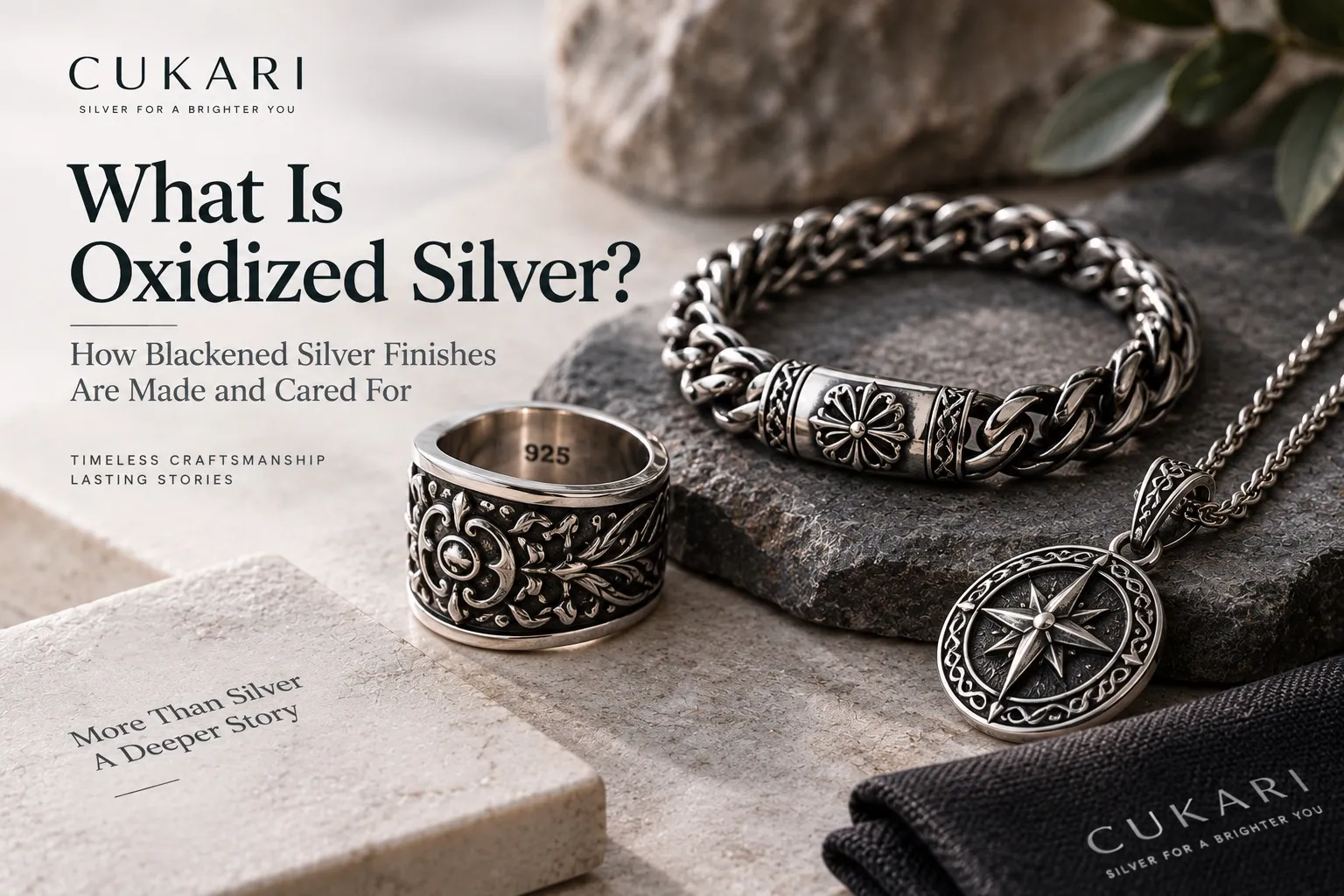
When people first see oxidized silver jewelry, the dark finish can be a little confusing. A ring may look almost black in the recessed areas while the raised details remain bright silver, and it is easy to assume that the piece has simply been allowed to tarnish or that a dark coating has been painted over the metal.
Neither explanation is quite right.
Oxidized silver is genuine silver that has been deliberately darkened as part of the finishing process. Jewelers use a controlled chemical treatment to create a dark surface, often leaving the higher areas polished while allowing the darker finish to remain in engraved lines, grooves and textured sections. The result is a piece with much stronger contrast and depth than uniformly polished silver.
There is also an interesting detail behind the name. In jewelry making, the term “oxidized silver” is widely used, but the blackening process commonly relies on sulfur compounds rather than simply exposing silver to oxygen. Jewelry-making references describe the process as a sulfur reaction that produces dark silver sulfide on the surface.
That distinction becomes useful when you are trying to decide whether a dark silver ring is intentionally finished, naturally tarnished, silver-plated, or simply in need of cleaning.
Table of Contents
- What Is Oxidized Silver?
- Is Oxidized Silver Real Silver?
- Why Is Silver Intentionally Oxidized?
- How Is Oxidized Silver Made?
- What Is Liver of Sulfur?
- Is Oxidized Silver the Same as Tarnished Silver?
- Oxidized Silver vs. Polished Silver
- Oxidized Silver vs. Silver-Plated Jewelry
- Does Oxidized Silver Wear Off?
- Where Does Oxidized Silver Wear First?
- How Do You Care for Oxidized Silver?
- What Should You Avoid When Cleaning Oxidized Silver?
- Can You Polish Oxidized Silver?
- Does Oxidized Silver Still Tarnish?
- Is Oxidized Silver Safe to Wear?
- When Does Oxidized Silver Make Sense?
- Foire aux questions
- What the Dark Finish Really Means
What Is Oxidized Silver?
Oxidized silver is silver jewelry that has been deliberately darkened on the surface to create a particular finish. The underlying jewelry can still be sterling silver, commonly marked 925, and the dark appearance is produced through a controlled chemical treatment rather than by replacing the silver with another metal.
The finish can range from a soft gray or gunmetal shade to a much deeper charcoal or black. What makes oxidized silver particularly recognizable is the way the dark surface is often used selectively. A jeweler may leave the recessed areas dark while polishing the raised edges back to bright silver, making an engraving, pattern or textured surface much easier to see.
This is why oxidized silver often has an antique, aged or slightly rugged appearance even when the jewelry itself is newly made. The darker areas create shadows that would be difficult to achieve with ordinary polishing alone.
The jewelry-making community commonly refers to sulfur-based treatments such as liver of sulfur when discussing this process. Ganoksin, a long-established jewelry-making resource, explains that liver of sulfur is traditionally used to darken or “antique” silver and that sulfur reacts with the silver surface to produce the gray and black tones associated with the finish.
The word “oxidized” can therefore be slightly misleading if you interpret it strictly as a reaction with oxygen. In jewelry terminology, however, oxidized silver, blackened silver and antiqued silver are all commonly used to describe this kind of deliberately darkened surface treatment, although the exact process and finish can vary from one maker to another.
Is Oxidized Silver Real Silver?
Yes. Oxidized silver can be completely genuine sterling silver.
The dark finish does not automatically mean that the jewelry is plated, painted or made from a cheaper metal. If a piece is made from 925 sterling silver and then intentionally oxidized, it remains sterling silver; the treatment simply changes the appearance of its surface.
Sterling silver itself contains 92.5% pure silver, with the remaining portion made up of other metals, commonly copper. The FTC recognizes “silver,” “sterling,” and “sterling silver” as terms for products containing at least 92.5% pure silver, while “925” refers to 925 parts silver per thousand.
An oxidized finish does not change that basic definition.
This is also why you should not judge the quality of silver jewelry simply by looking at whether it is bright and shiny. A dark surface can be an intentional design choice rather than a sign that the silver has deteriorated.
If you are still getting familiar with silver markings, our guide to what 925 means on silver jewelry explains what the 925 mark tells you and, just as importantly, what it does not prove by itself.
Why Is Silver Intentionally Oxidized?
The main reason is visual.
Polished silver reflects light strongly and has a clean, bright appearance. That look works beautifully for simple chains, smooth bangles and highly polished rings, but intricate silver jewelry can sometimes lose some of its detail when every part of the surface reflects light in roughly the same way.
Darkening the recessed areas changes that.
Imagine a ring with engraved lines running across the surface. If the entire ring is polished to the same bright finish, the engraving may be visible but relatively subtle. Once the recessed lines are darkened and the raised edges are polished, the pattern becomes much easier to see. The dark areas absorb more light while the raised silver catches it, creating a visual contrast that gives the design more depth.
This is particularly useful for:
- engraved rings
- textured bracelets
- carved pendants
- intricate chains
- antique-inspired jewelry
- designs with deep grooves or recessed details
The effect is not necessarily meant to make the jewelry look old. A modern designer can use the same technique to create a darker, more graphic appearance, while another maker may use it to give a piece a traditional or handmade character.
In that sense, oxidization is better understood as a finishing technique than as a way of changing what the jewelry is made from.
How Is Oxidized Silver Made?
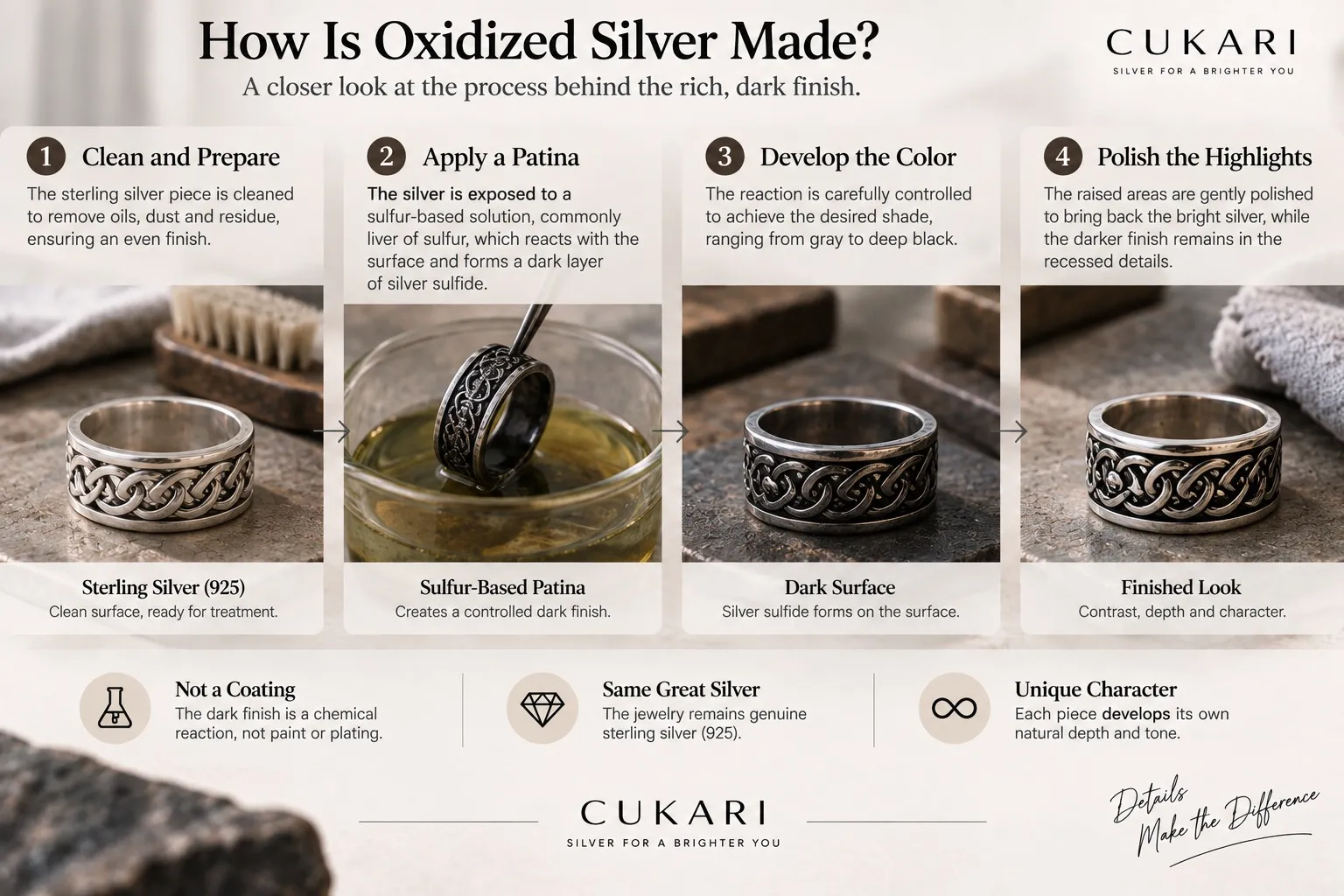
The exact process varies between jewelers and workshops, but the basic idea is straightforward: the finished silver surface is exposed to a chemical treatment that deliberately creates a dark patina.
One of the most traditional approaches uses a sulfur-based compound such as liver of sulfur. Jewelry-making references describe the process as a controlled reaction in which sulfur compounds react with the silver surface and produce dark sulfide compounds.
A typical finishing process may look something like this:
The silver is prepared
The jewelry needs to be clean before the patina is applied. Oils, dirt and residue can interfere with how evenly the treatment reacts with the metal.
The darkening treatment is applied
The piece is exposed to a suitable sulfur-based solution or another professional blackening treatment. The reaction can move quickly, so the jeweler controls the treatment rather than simply leaving the piece in the solution indefinitely.
The desired color is developed
Depending on the process and timing, the surface can develop different shades rather than immediately becoming a uniform black.
The raised areas are polished
This is one of the most important steps in creating the classic oxidized-silver appearance. The jeweler can remove much of the dark finish from the raised portions while leaving it in recessed areas.
The result is a contrast between bright silver highlights and darkened details.
Rio Grande’s technical material on silver patination likewise describes using liver of sulfur to darken silver and then polishing the high points to bring the brighter metal back into the design.
That selective finishing is often what separates an intentionally oxidized piece from silver that has simply been left to tarnish.
What Is Liver of Sulfur?
Liver of sulfur is a traditional jewelry-making material used to create patinas on silver and other metals. Despite its name, it is not literally made from animal liver. It is a mixture of sulfur-containing compounds, historically used by metalsmiths to darken silver and create different patina effects.
When used on silver, it can produce colors that develop through different stages before reaching a darker gray or black appearance. Experienced metalsmiths can control the result through factors such as concentration, temperature, timing and the condition of the metal surface.
The material is also known for its strong unpleasant sulfur smell, which is one reason jewelry-making references recommend working with appropriate ventilation when using it.
This is worth mentioning because some online tutorials make silver oxidation look like an easy household experiment. Professional jewelry finishing is more controlled than that. If you own finished jewelry, there is generally no reason to try oxidizing it yourself simply to make it darker. An uncontrolled treatment can produce an uneven finish or affect other materials in the piece.
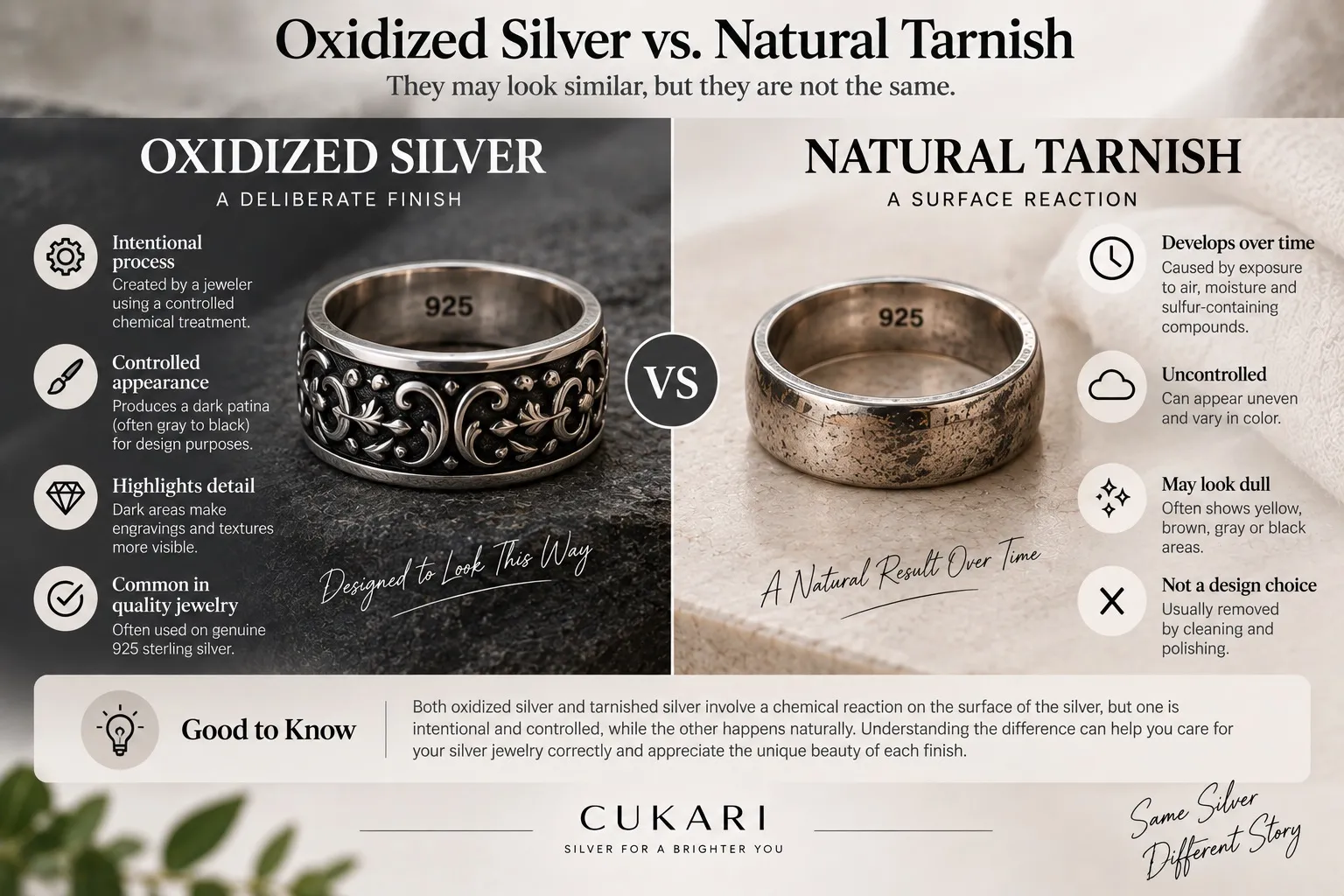
Is Oxidized Silver the Same as Tarnished Silver?
They are related, but they are not the same thing.
Both involve chemical changes at the surface of silver, and both can produce dark colors. The important difference is intention and control.
Natural tarnish develops gradually as silver reacts with substances in its environment. Sulfur-containing compounds, humidity and other environmental factors can contribute to tarnishing. The result may be uneven, especially in areas that are more exposed to the surrounding environment. The Sheffield Assay Office explains that silver tarnish can develop through reactions involving sulfur-containing gases and that its appearance can change as the surface layer becomes thicker.
Oxidized silver, by contrast, has been deliberately treated to create a particular appearance.
A jeweler may want the dark color to remain inside engraved lines while the edges stay bright. Natural tarnish does not conveniently follow the design of the jewelry in that way.
There is also a practical difference in how you should treat them. If bright sterling silver has developed unwanted tarnish, cleaning and polishing may be appropriate. If the jewelry was intentionally oxidized, aggressive polishing may remove the very finish that gives the piece its character.
That distinction is particularly important when caring for textured or engraved jewelry.
Oxidized Silver vs. Polished Silver
The difference between oxidized and polished silver is mainly one of surface appearance and finishing technique, not necessarily material quality.
Polished sterling silver has a bright, reflective surface. Light moves across the metal with relatively little visual interruption, making it particularly suitable for clean, minimalist designs.
Oxidized sterling silver has deliberately darkened areas, often combined with polished highlights. The contrast can make texture more visible and give the jewelry a deeper, more dimensional appearance.
Neither finish is automatically better.
A smooth polished bangle may suit someone who likes a clean and understated look, while a darkened engraved ring may appeal to someone who wants the texture to be much more noticeable. The choice is largely about the design and the way you want the jewelry to look when you wear it.
If you are comparing different types of sterling silver jewelry, you can also explore CUKARI’s women’s sterling silver bracelets et women’s sterling silver bangles to see how different silver finishes interact with different forms.
Oxidized Silver vs. Silver-Plated Jewelry
This is another distinction that causes confusion because both types of jewelry can have surfaces that look different from bright silver.
With oxidized sterling silver, the darkened appearance is created by treating the surface of the silver itself. The jewelry underneath remains the same silver material.
With silver-plated jewelry, a layer of silver is applied over another base metal. The FTC specifically distinguishes silver-plated products from sterling silver products because the silver is a surface layer rather than the material making up the entire piece.
That difference becomes important if the surface is scratched or worn.
An oxidized sterling silver ring may gradually show brighter silver where the dark patina has worn away. A silver-plated piece can eventually reveal the underlying base metal if enough of the plating is removed.
If you are unsure about the difference, our guide to sterling silver vs. silver-plated jewelry explains the construction, markings and signs you can look for before buying.
Does Oxidized Silver Wear Off?
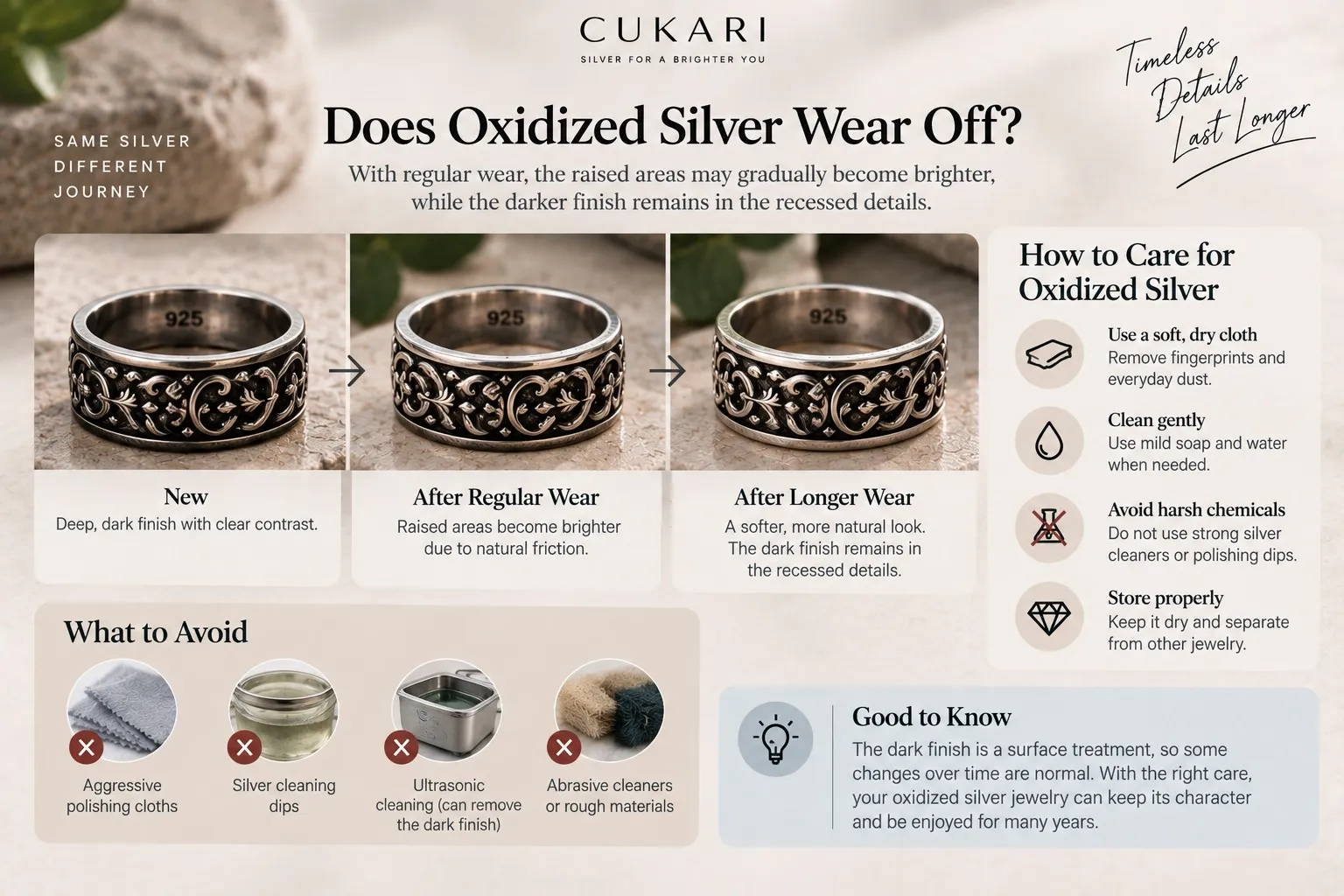
Yes, the dark finish can become lighter with wear.
This is one of the most important things to understand before buying oxidized silver jewelry. The darkened surface is a relatively thin surface treatment, so areas that experience repeated friction can gradually become brighter.
That does not necessarily mean the jewelry is defective.
Think about the parts of a ring that touch your fingers throughout the day. The outer edges and raised surfaces are constantly rubbing against skin, clothing and other objects. Those areas may gradually become brighter, while the recessed parts remain dark because they are much less exposed to friction.
The same thing can happen with bracelets, particularly around the clasp, edges and sections that repeatedly rub against the wrist.
Some people actually prefer this gradual change because it gives the jewelry a more individual appearance. A new oxidized ring may have strong contrast between black recesses and bright edges; after months or years of wear, the transition can become softer and more natural.
Jewelry makers and specialist guides commonly describe this gradual change as part of the nature of a surface patina rather than as damage to the underlying silver.
Where Does Oxidized Silver Wear First?
The answer depends on how the jewelry is worn.
Anneaux
Rings usually experience more friction than necklaces because your hands are constantly moving and coming into contact with other surfaces. Raised areas can therefore become brighter relatively quickly.
Bracelets
Bracelets move against the wrist, clothing and nearby objects, so the edges and exposed high points may gradually lose some of their darker finish.
Colliers
Necklaces often retain their oxidized appearance longer because they experience less direct friction, although chains and pendants can still rub against skin and clothing.
Boucles d'oreilles
Earrings generally have relatively little surface friction compared with rings and bracelets, so an oxidized finish can remain visually consistent for longer.
These are general patterns rather than fixed rules. A ring worn occasionally may retain its finish for years, while a bracelet worn every day may show brighter contact points much sooner.
How Do You Care for Oxidized Silver?
Oxidized silver needs slightly different care from bright, polished sterling silver because the dark surface is part of the design.
The main idea is simple: clean the jewelry without trying to polish the dark finish away.
For routine care, a soft, dry cloth is often enough to remove fingerprints, light surface residue and everyday dust. If the jewelry needs more cleaning, use a gentle approach rather than a strong silver-polishing treatment.
Water and mild soap may be suitable for some oxidized pieces, but the construction of the jewelry matters. If it contains gemstones, porous materials, pearls or delicate components, the cleaning method may need to be adjusted.
For this reason, you should not automatically apply the same cleaning routine you would use for a plain polished silver bracelet.
Our detailed guide on how to clean sterling silver jewelry safely explains why different silver finishes and jewelry materials need different approaches.
Storage matters as well. Keeping the jewelry dry and separated from pieces that could scratch it will help preserve both the silver and its finish. Our guide on how to store sterling silver jewelry covers the storage side in more detail.
What Should You Avoid When Cleaning Oxidized Silver?
The biggest mistake is treating the dark finish as though it were unwanted tarnish.
If you use a strong polishing cloth across the entire surface of an intentionally oxidized ring, you may brighten the raised sections, but you can also remove the dark areas that were deliberately left in the recesses.
The same problem can occur with abrasive polishing compounds and some silver-cleaning dips. A product that works well for restoring bright sterling silver can be exactly the wrong choice for preserving a blackened finish.
Ultrasonic cleaning should also not be treated as a universal solution for oxidized jewelry. The construction of the piece, the stones it contains and the type of finish all matter, and aggressive cleaning can affect a deliberately applied patina. Jewelry-making discussions specifically caution that some ultrasonic processes can remove oxidized finishes.
If you are unsure whether the dark surface is intentional, do not start polishing it until you know what you are looking at.
That small precaution can save you from removing a finish that cannot simply be put back with another few minutes of polishing.
Can You Polish Oxidized Silver?
You can polish parts of oxidized silver, but that is different from polishing the entire piece as you would a bright sterling silver ring.
In professional finishing, selective polishing is often part of the process used to create oxidized jewelry in the first place. The dark treatment is applied and then the raised areas are brought back to a brighter finish, leaving the darker material in the recessed details.
At home, however, it is much harder to control exactly where the finish is removed.
If you rub the entire surface with a polishing cloth, you may gradually flatten the contrast between the bright and dark areas. On a heavily textured design, that can change the appearance quite noticeably.
If the jewelry has become brighter in a few high-contact areas naturally, there may be no need to “fix” it. That gradual variation is often part of how oxidized silver ages.
Does Oxidized Silver Still Tarnish?
It can still undergo surface reactions because it is still silver.
The difference is that an intentionally darkened surface already has a patina, so ordinary tarnishing is not always as visually obvious as it would be on highly polished silver. The finish may also change gradually as the jewelry is exposed to air, moisture, skin oils and friction.
The important point is that oxidized silver does not become chemically immune to its environment.
The dark finish may wear lighter in some places, deepen or change subtly in others, and gradually develop a slightly different appearance from the day it was purchased.
This is another reason not to judge oxidized silver by the same standard as mirror-polished jewelry. The appeal of the finish often lies partly in its variation.
If you want to understand why ordinary sterling silver darkens naturally, our article on does sterling silver rust explains the difference between rust and silver tarnish in more detail.
Is Oxidized Silver Safe to Wear?
An intentionally oxidized sterling silver piece is still sterling silver with a surface treatment, so the dark appearance itself does not mean that the jewelry is made from an unsafe metal.
What matters when choosing jewelry for sensitive skin is the actual material and construction, rather than simply whether the silver is bright or dark.
A 925 mark tells you about the silver content claimed for the jewelry, but it does not by itself answer every question about trace metals, coatings, solder, stones or other components.
If sensitive skin is one of your concerns, our guide to whether sterling silver is hypoallergenic explains why “hypoallergenic” should not be treated as a guarantee that every person will react in exactly the same way.
When Does Oxidized Silver Make Sense?
Oxidized silver tends to work particularly well when the design has texture that benefits from stronger contrast.
A completely smooth silver surface does not always need a dark finish. On an engraved ring, however, the darkened grooves can make the pattern much easier to see. The same is true of a textured bracelet where the darker recesses create shadows between raised sections.
It can also be a good choice if you prefer silver that looks less traditionally polished. Some people like the clean brightness of freshly polished sterling silver, while others prefer the deeper gray and black tones of an antique-inspired finish.
Neither preference is more correct.
The important thing is to understand what you are buying. If you expect oxidized silver to remain uniformly black forever, you may be surprised when the raised edges become brighter through normal wear. If you understand from the beginning that the finish is part of the surface and will gradually respond to friction, the changes become much easier to appreciate.
Frequently Asked Questions About Oxidized Silver
Is oxidized silver real silver?
Yes. Oxidized silver can be genuine 925 sterling silver that has been deliberately darkened as a surface treatment. The dark finish does not automatically mean that the jewelry is silver-plated or made from a different metal.
Is oxidized silver the same as black silver?
In everyday jewelry descriptions, “blackened silver,” “oxidized silver” and “antiqued silver” are often used for similar darkened finishes. The exact chemical treatment can vary, so the terminology does not always describe one single manufacturing process.
Does oxidized silver turn black naturally?
Natural silver tarnish can also become dark gray or black, but intentionally oxidized silver is darkened deliberately during manufacturing or finishing. The difference is that the desired appearance is created under controlled conditions rather than left entirely to natural tarnishing.
Will oxidized silver fade?
The dark finish can gradually become lighter in areas that experience frequent rubbing. Rings and bracelets often show this more quickly than necklaces or earrings because they have more contact with skin and other surfaces.
Can I use a silver polishing cloth on oxidized silver?
A polishing cloth can remove some of the dark surface, especially on raised areas. If you want to preserve the original oxidized appearance, avoid polishing the entire piece aggressively.
Can oxidized silver be cleaned with jewelry cleaner?
It depends on the particular finish and the other materials in the jewelry. Many strong silver-cleaning products are intended to remove tarnish and can therefore lighten or strip an intentional dark patina. When preserving the finish is important, gentle cleaning is generally preferable.
Is oxidized silver better than polished silver?
Neither finish is inherently better. Polished silver gives you a brighter and more reflective appearance, while oxidized silver creates stronger contrast and emphasizes texture and engraving. The choice depends mainly on the design and the look you prefer.
Does oxidized silver contain real 925 silver?
It can. If the jewelry is made from 925 sterling silver, the darkened finish is simply an additional surface treatment. Look at the material description and hallmark rather than assuming that the color tells you what the jewelry is made from.
Can I wear oxidized silver every day?
Yes, many oxidized silver pieces are designed to be worn regularly. Just keep in mind that everyday friction can gradually brighten the areas that receive the most contact, particularly on rings and bracelets.
What the Dark Finish Really Means
The easiest way to understand oxidized silver is to stop thinking of the dark color as something that has happened à the jewelry and start thinking of it as something that was deliberately done to finish the jewelry.
The silver underneath can still be genuine 925 sterling silver. The darker surface is there to change the way light interacts with the design, bringing out engraved lines, texture and recessed details that might otherwise disappear against bright polished metal.
It is also a finish that can change with use. The dark areas may remain in protected recesses while raised edges gradually become brighter from everyday contact. That does not necessarily make the jewelry look worse; depending on the design, the changing contrast can become part of its character.
The main thing to remember when caring for oxidized silver is therefore quite simple: do not clean away the finish you bought the jewelry for.
If you are treating ordinary tarnish on bright sterling silver, polishing may be exactly what you want. With intentionally oxidized silver, the darker surface is part of the design, so gentler care usually makes much more sense.