
Does Sterling Silver Rust? Silver Rust vs Tarnish Explained
If you have ever taken a sterling silver ring or bracelet out of a drawer and found that it has turned brown, gray, or almost black, you may have wondered whether the metal has started to rust. The word “rust” is often used for any kind of reddish, brown, or dark discoloration, so it is an understandable question, especially when the jewelry no longer looks anything like it did when you bought it.
The good news is that sterling silver does not rust in the same way that iron or steel does. What you are usually seeing is tarnish, surface discoloration, or, in some cases, a reaction involving another metal or a worn plated surface. Sterling silver itself can certainly change appearance over time, but calling that change “rust” can make it harder to understand what is actually happening to the jewelry.
Knowing the difference matters because the right way to care for tarnished silver is very different from the way you would deal with rust on iron.
Table of Contents
- Does Sterling Silver Rust?
- What Is the Difference Between Rust and Tarnish?
- Why Does Sterling Silver Tarnish?
- What Happens to the Copper in Sterling Silver?
- What Does Tarnished Sterling Silver Look Like?
- Can Sterling Silver Corrode?
- Why Does Sterling Silver Sometimes Turn Black?
- Can Sterling Silver Turn Green?
- Does Water Make Sterling Silver Rust?
- Can Salt Water and Chlorine Damage Sterling Silver?
- How Do You Remove Tarnish From Sterling Silver?
- What Should You Avoid When Cleaning Tarnished Silver?
- How Can You Prevent Sterling Silver From Tarnishing?
- Does Pure Silver Rust or Tarnish?
- Does Silver-Plated Jewelry Rust?
- When Should You Be Concerned About Discoloration?
- Frequently Asked Questions About Sterling Silver Rust
- What You Are Seeing on Your Silver Jewelry
Does Sterling Silver Rust?
No, sterling silver does not rust like iron or steel.
Sterling silver is an alloy containing 92.5% pure silver, with the remaining portion made up of other metals. Copper is commonly used because pure silver is relatively soft and needs additional strength for many types of jewelry. Jewelers of America specifically notes that sterling silver can tarnish or darken, but does not rust.
That distinction is useful when you are trying to figure out what happened to an older piece of jewelry.
If a sterling silver bracelet has developed a dark surface after sitting in a jewelry box for several months, the most likely explanation is tarnish, not rust. If a ring has developed a greenish mark, there may be another explanation involving copper, skin chemistry, moisture, or a plated surface. If you see something that is distinctly orange or reddish, it is worth looking more closely at the piece rather than assuming that the silver itself has rusted.
In other words, a change in color does not automatically mean the jewelry has been damaged beyond repair.
What Is the Difference Between Rust and Tarnish?
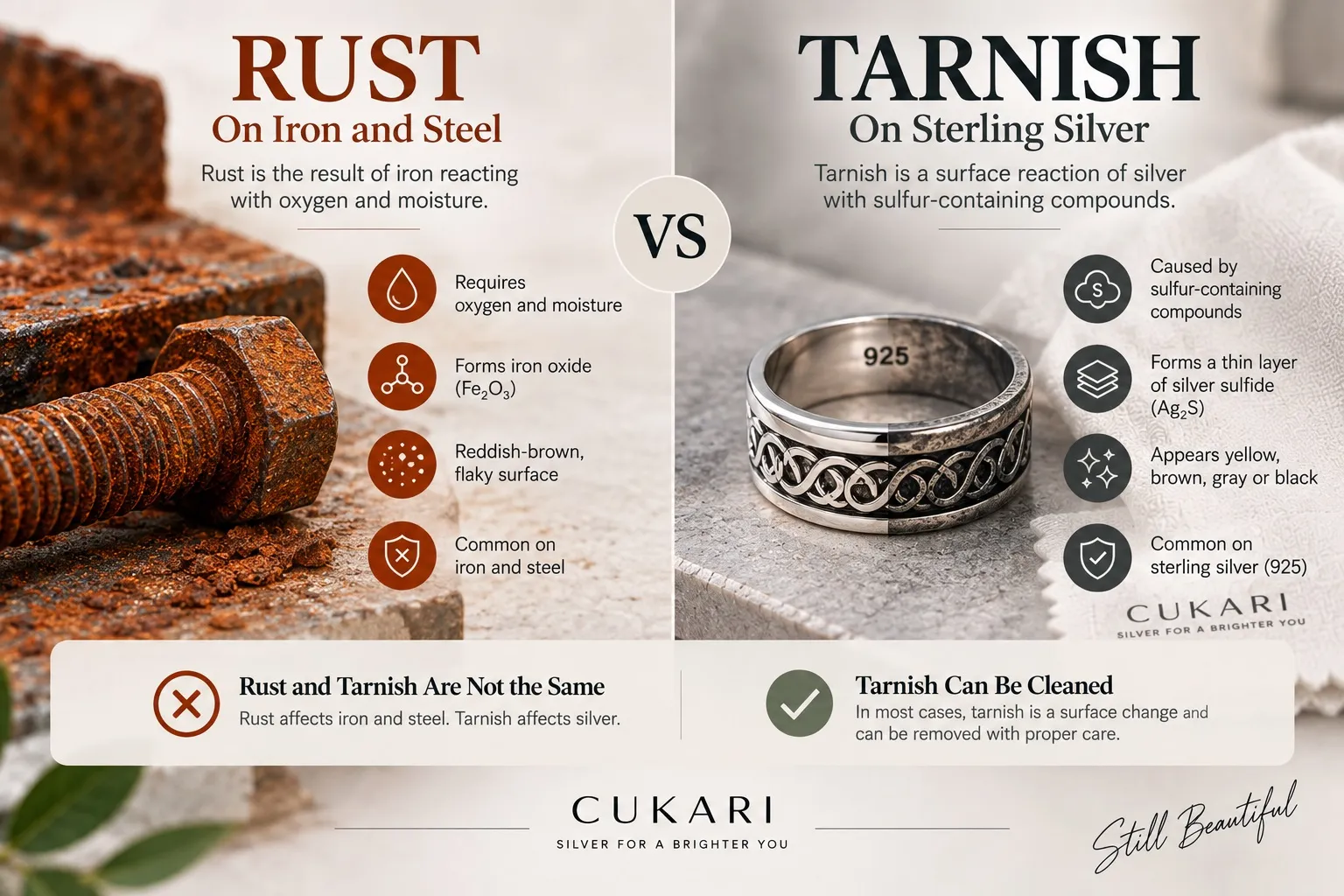
Rust and tarnish are both forms of metal surface change, but they are not the same thing.
The term rust is normally associated with iron and steel. It develops when iron reacts with oxygen and moisture, producing iron oxides and related corrosion products. The familiar reddish-brown coating on an old steel tool or bicycle is a typical example.
Silver behaves differently.
Silver can react with substances in its surroundings and develop a surface layer known as tarnish. Sulfur-containing compounds in the air are particularly important in this process. The Sheffield Assay Office explains that sterling silver contains silver and other metals such as copper, and that sulfur-containing gases can react with these metals to produce sulfide compounds on the surface.
This is why a piece of sterling silver can gradually lose its bright appearance even when it has never been exposed to anything that would cause iron to rust.
The distinction becomes especially helpful when someone says that their silver jewelry has “rusted.” In many cases, they are simply describing tarnish in everyday language.
Why Does Sterling Silver Tarnish?
Tarnishing is a normal part of owning silver jewelry. It does not necessarily indicate poor-quality silver, and it does not mean that the jewelry has reached the end of its useful life.
Silver reacts with its environment over time, particularly when it is exposed to sulfur-containing compounds. The rate of tarnishing depends on the surrounding conditions, which is one reason two pieces of sterling silver kept in different homes can look very different after the same amount of time.
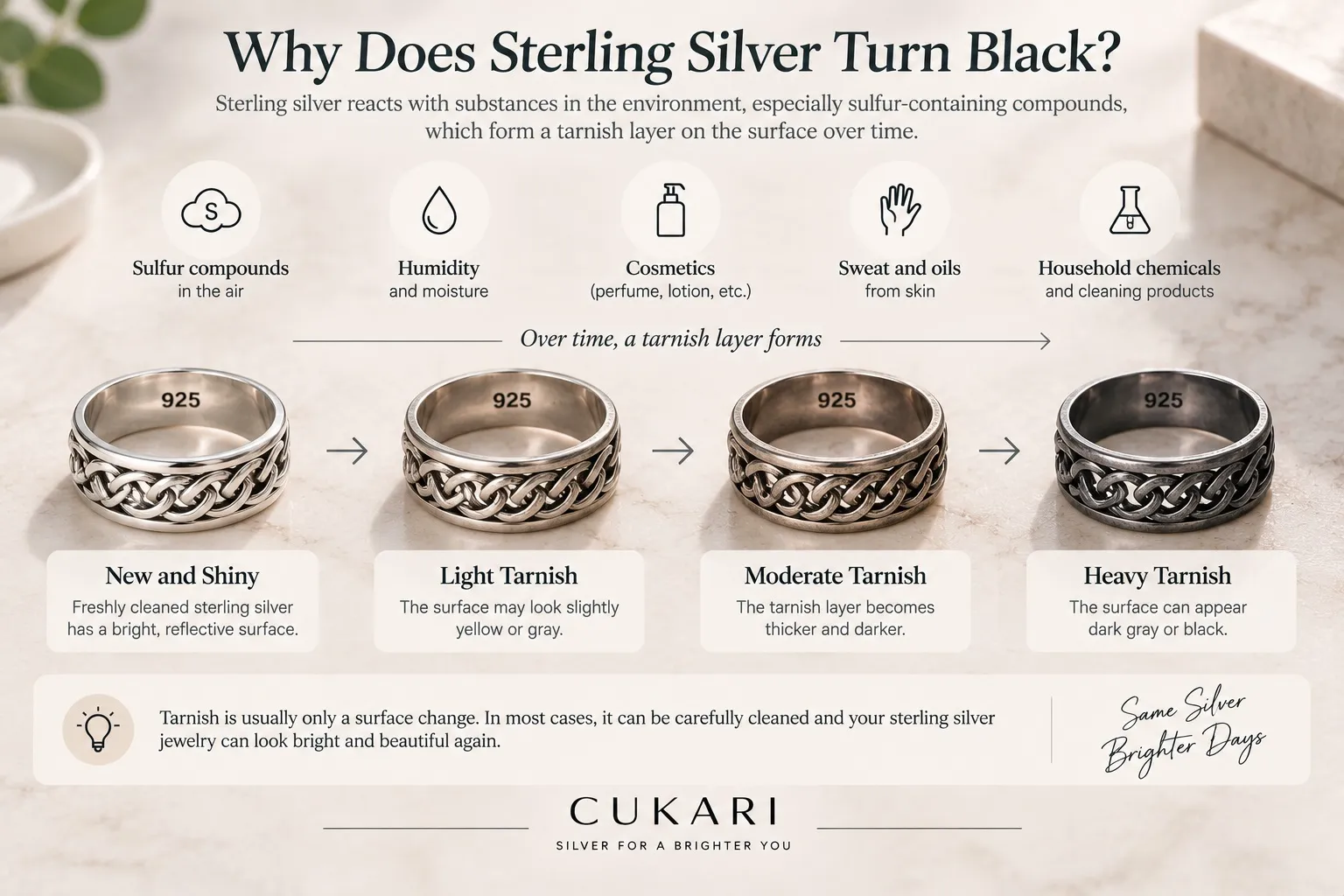
Humidity also matters. Silver tends to tarnish more quickly in more humid conditions, and moisture left on the surface can make the situation worse. Perspiration, fingerprints, cosmetics and other substances that remain on jewelry can also contribute to surface changes.
This is one reason a bracelet that is worn frequently may need cleaning sooner than a necklace that spends most of its time in a dry jewelry box.
If you want to understand the darker discoloration often seen on silver, our guide to why sterling silver jewelry turns black goes into the process in more detail.
What Happens to the Copper in Sterling Silver?
The copper in sterling silver is there for a practical reason. Pure silver is relatively soft, so adding other metals makes the finished alloy more suitable for jewelry that has to withstand bending, handling and everyday wear. Sterling silver is generally 92.5% silver, with the balance consisting of other metals, commonly copper.
Copper can also take part in the surface reactions that occur as sterling silver tarnishes.
The Sheffield Assay Office explains that copper in sterling silver can react with sulfur-containing gases to form copper sulfide, while silver itself can also form silver sulfide. The resulting tarnish layer can change in appearance as it becomes thicker, ranging from lighter shades through darker brown and eventually black.
This is why it is not quite accurate to describe every darkening of sterling silver simply as “the silver oxidizing.” The alloy contains more than silver, and the surrounding environment plays an important role in what develops on the surface.
If you are interested in the material itself, you can also read our guide to what 925 means on silver jewelry.
What Does Tarnished Sterling Silver Look Like?
Freshly polished sterling silver has the bright, reflective appearance most people expect from silver jewelry. Tarnished silver can look very different.
Light tarnish may appear slightly yellow, gray, or brown. As the tarnish layer develops, the surface can become much darker, sometimes appearing almost black. The Sheffield Assay Office describes this progression as a change in the optical appearance of the thin tarnish layer as it becomes thicker.
The location of the discoloration can also give you clues.
A bracelet that has become dull across its entire surface is likely dealing with ordinary tarnish. A ring with dark areas concentrated in small recesses may simply have accumulated tarnish where the surface is difficult to polish. On the other hand, an unusual green, orange, or reddish area deserves a closer look because it may involve copper-containing compounds, residue, or another material rather than ordinary silver tarnish.
The important thing is not to judge the condition of the jewelry from color alone.
Can Sterling Silver Corrode?
Silver does not rust like iron, but that does not mean it is completely unaffected by its surroundings.
Silver and the other metals in sterling silver can undergo chemical reactions at the surface. In everyday jewelry care, the visible result is most often described as tarnishing or discoloration. Under certain conditions, corrosion can also occur, particularly when the metal is repeatedly exposed to moisture, salts, chemicals, or other reactive substances.
This is one reason jewelry care is about more than simply making silver look shiny.
Perfume, hairspray, lotions, perspiration, household chemicals and prolonged exposure to moisture can all create less favorable conditions for silver jewelry. The Sheffield Assay Office recommends removing silver jewelry before activities such as swimming, bathing, housework and gardening, and avoiding unnecessary exposure to products such as perfume and hairspray.
For normal everyday wear, this does not mean you need to treat sterling silver like a museum object. It simply means that repeated exposure to harsh conditions can shorten the time between cleanings and, in some cases, contribute to surface damage.
Why Does Sterling Silver Sometimes Turn Black?
Black sterling silver is usually showing a relatively advanced stage of tarnishing.
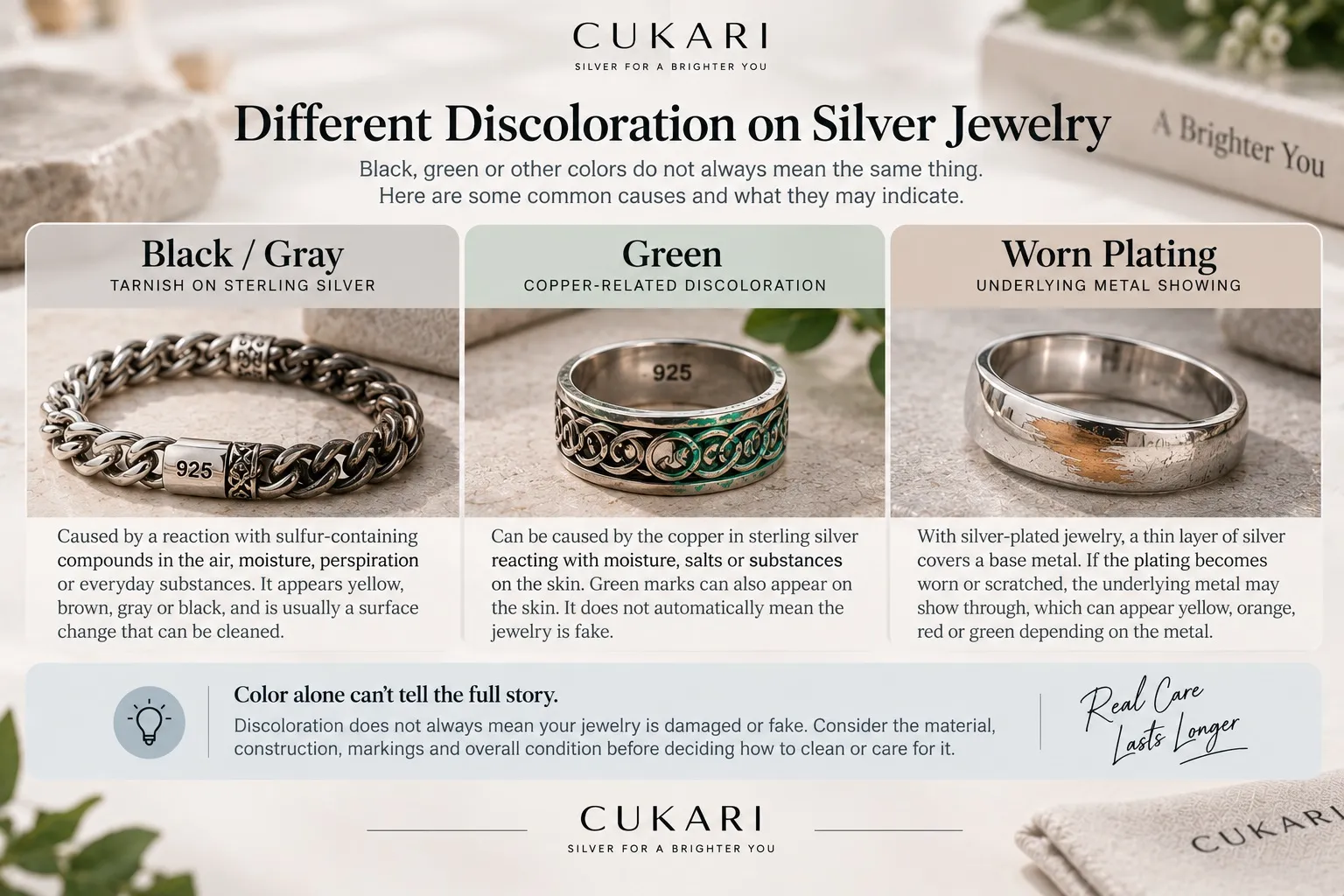
Silver can react with sulfur-containing substances in the surrounding environment, producing silver sulfide. The surface layer becomes darker as it develops, which is why a piece that was once bright and reflective can eventually look gray or almost completely black.
This can happen even when the jewelry has not been worn for a long time.
In fact, jewelry that sits untouched in a drawer is not necessarily protected from tarnish. The air inside the storage environment, humidity and the materials surrounding the jewelry can all affect how quickly the surface changes. Certain packaging materials can also release compounds that accelerate tarnishing.
If your jewelry has turned black, that does not automatically mean the silver is fake or ruined. In many cases, the original surface can be restored with appropriate cleaning and polishing.
Can Sterling Silver Turn Green?
Green discoloration is a little more complicated than ordinary black or gray tarnish.
Sterling silver contains other metals, commonly copper, and copper-containing materials can develop green corrosion products under certain conditions. Moisture, salts and exposure to the skin can all influence what happens at the surface.
There is another possibility that is often overlooked: the jewelry may not be solid sterling silver throughout. If a piece is silver-plated and the outer silver layer becomes worn or damaged, the underlying metal can become exposed. The FTC distinguishes silver-plated products from sterling silver because silver plating consists of a layer of silver applied over a base metal.
So, if you notice green discoloration, don’t immediately conclude that genuine sterling silver has somehow “turned green.”
Our more detailed guide, Does Sterling Silver Turn Green?, explains the different causes and what you can look for before deciding how to clean the piece.
Does Water Make Sterling Silver Rust?
Ordinary water does not make sterling silver rust because silver is not an iron-based metal.
That does not mean water exposure is completely harmless.
A quick rinse is very different from leaving jewelry wet for long periods or wearing it repeatedly in environments where it is exposed to moisture, salts and chemicals. Humidity itself can increase the rate at which silver tarnishes, while perspiration and substances left on the skin can also affect the metal’s surface.
If your bracelet gets wet occasionally, there is no reason to panic. Dry it properly rather than putting it straight back into a closed jewelry box while it is still damp.
For jewelry that you wear regularly, developing that small habit can make a noticeable difference over time.
Can Salt Water and Chlorine Damage Sterling Silver?
Salt water and chlorinated water deserve more caution than clean tap water.
Swimming pools contain chemicals designed to keep the water sanitary, while seawater contains dissolved salts. Neither environment is particularly helpful for maintaining the original appearance of silver jewelry, especially when exposure is frequent.
The Sheffield Assay Office recommends removing silver jewelry before swimming or bathing and avoiding contact with various household and cosmetic chemicals.
There is also a practical reason for taking jewelry off before swimming. Rings, bracelets and chains can catch on equipment or clothing, and stones or delicate settings can be affected by repeated exposure to chemicals and physical movement.
For those reasons, taking your silver jewelry off before entering a pool or the ocean is a simple precaution that costs nothing.
How Do You Remove Tarnish From Sterling Silver?
If your sterling silver has developed light or moderate tarnish, you usually do not need an aggressive cleaning method.
Start by identifying what kind of jewelry you are dealing with. Plain sterling silver is easier to clean than an oxidized finish, silver-plated piece, or jewelry containing delicate gemstones.
For ordinary sterling silver, a gentle cleaning process is usually the safest place to start: use lukewarm water, a mild soap when appropriate, and a soft cloth. After rinsing, dry the jewelry thoroughly before storing or wearing it again.
Once the surface is completely dry, a suitable silver polishing cloth can be used to restore some of the original brightness.
The important part is patience. Tarnish is a surface problem, so there is rarely a good reason to attack it with a highly abrasive method.
For a more detailed step-by-step process, see our guide on how to clean sterling silver jewelry safely.
What Should You Avoid When Cleaning Tarnished Silver?
A quick search for silver-cleaning advice will bring up plenty of homemade recipes involving toothpaste, baking soda, aluminum foil, vinegar and other household ingredients. Some of these methods can produce a visible result, but that does not make them appropriate for every piece of jewelry.
The problem is that silver jewelry is not always just a flat piece of plain metal.
A bracelet may have a polished finish. A ring may have deliberately darkened recesses. A necklace may contain stones. A plated piece may have only a very thin silver surface. Aggressive cleaning can remove or damage these finishes even when the jewelry looks brighter immediately afterward.
The Sheffield Assay Office specifically warns that various improvised cleaning methods can have unwanted long-term consequences and recommends using appropriate materials while avoiding unnecessary cleaning and surface wear.
There is also a simple rule worth remembering: if you do not know what the finish or construction of the jewelry is, start with the gentlest reasonable method rather than the strongest one.
How Can You Prevent Sterling Silver From Tarnishing?
You cannot stop silver from tarnishing forever, but you can slow the process considerably.
The first thing to consider is where the jewelry spends most of its time when you are not wearing it. A dry environment is preferable to a damp bathroom, basement or other humid area. The Sheffield Assay Office recommends dry storage and suggests using tarnish-reducing bags or jewelry pouches, along with moisture-absorbing materials such as silica gel.
It is also better to keep individual pieces from rubbing against each other unnecessarily. Separate compartments or pouches help reduce scratches as well as making it easier to find a particular bracelet or ring later.
Before putting jewelry away, wipe away moisture, fingerprints and cosmetic residue. If you have been wearing a bracelet throughout a warm day, for example, taking a few seconds to wipe it with a soft cloth before storage is a much better habit than putting it away while it is still covered with sweat and skin oils.
For a more complete storage routine, see How to Store Sterling Silver Jewelry.
If you are buying sterling silver bracelets, keeping them properly stored between wears can make maintenance much easier. You can browse our women’s sterling silver bracelets for different chain and bracelet styles.
Does Pure Silver Rust or Tarnish?
Pure silver does not rust like iron either.
It is worth remembering, though, that higher silver purity does not mean the metal can never change appearance. The Sheffield Assay Office notes that pure silver can also react with sulfur-containing compounds and form silver sulfide, although its behavior differs from sterling silver because it does not contain the same alloying metals.
This is one reason the choice between 999 fine silver and 925 sterling silver should not be reduced to the idea that one is simply “better.” They have different levels of purity and different physical characteristics.
If you are interested in that comparison, our article on sterling silver vs. pure silver explains how 925 and 999 silver differ in composition, softness, durability and everyday use.
Does Silver-Plated Jewelry Rust?
This is where the word “rust” can become particularly confusing.
Silver-plated jewelry has a layer of silver applied over another metal. The FTC distinguishes silver-plated products from sterling silver because the silver is a surface coating rather than the material making up the entire piece.
If that outer layer becomes worn, scratched or damaged, the metal underneath can become visible. Depending on what that underlying metal is and how it reacts with moisture or the surrounding environment, the discoloration may look very different from ordinary silver tarnish.
That is one reason a piece that has developed an orange, reddish, yellowish or greenish area should not automatically be treated as tarnished sterling silver.
If you are unsure what you bought, take a closer look at the product description and markings before reaching for a polishing compound. Our guide to sterling silver vs. silver-plated jewelry explains the construction differences and some practical ways to tell them apart.
When Should You Be Concerned About Discoloration?
Most ordinary tarnish is not a reason to panic.
A darkened sterling silver ring, bracelet or necklace can often be cleaned and returned to a much brighter appearance. Even fairly heavy tarnish does not automatically mean the underlying silver has been destroyed.
There are situations, however, where it makes sense to stop experimenting with home cleaning methods.
If you see deep scratches, flaking, an unusual coating, exposed base metal, loose stones, damaged settings or discoloration that does not respond to gentle cleaning, professional inspection may be worthwhile. The same applies to valuable or particularly delicate jewelry where removing a little too much surface material could affect the finish.
And if you are trying to determine whether a bracelet is actually sterling silver in the first place, discoloration alone is not a reliable test. Look at the material description, markings and seller information instead. Our guide on how to tell if a 925 sterling silver bracelet is real covers the subject in greater detail.
Frequently Asked Questions About Sterling Silver Rust
Can sterling silver get rusty?
Sterling silver does not rust in the same way as iron or steel. When silver jewelry develops a dark or discolored surface, it is usually tarnish or another form of surface reaction rather than iron rust.
Why does my sterling silver look brown?
Brown or yellow-brown discoloration can be part of the normal progression of silver tarnish. The appearance of tarnish changes as the surface layer develops, so silver does not always go directly from bright to black.
Why does sterling silver turn black?
Silver can react with sulfur-containing compounds in the environment and form sulfide compounds on its surface. As the tarnish layer becomes thicker, it can appear increasingly dark and eventually black.
Can water damage sterling silver?
Water does not make sterling silver rust, but prolonged exposure to moisture can contribute to tarnishing, particularly when combined with salts, chemicals or other substances. Drying the jewelry after it becomes wet is a sensible habit.
Can sterling silver turn green?
Green discoloration can occur under certain conditions involving copper-containing materials, moisture and surface reactions. It can also be a sign that another metal is involved, particularly with plated jewelry. Green discoloration should therefore be considered separately from ordinary black or gray silver tarnish.
Does sterling silver tarnish faster when it is not worn?
It can. Silver does not need to be worn in order to tarnish because it reacts with substances in the surrounding environment. Humidity, sulfur-containing compounds and even some packaging materials can affect how quickly tarnish develops.
Is tarnished sterling silver ruined?
Usually not. Tarnish is generally a surface change, and properly cleaned sterling silver can often regain much of its original appearance. The appropriate cleaning method depends on the jewelry’s finish, construction and any stones or other materials it contains.
Does 925 silver rust?
No. “925” indicates that the material contains 92.5% pure silver, and 925 sterling silver does not rust like iron. It can, however, tarnish and darken over time.
Why does silver jewelry sometimes have orange or reddish marks?
Orange or reddish discoloration can have several possible causes, including reactions involving other metals, surface contamination or wear that exposes an underlying material. Because the appearance alone does not identify the cause, it is better to inspect the jewelry’s construction rather than assume that the silver itself has rusted.
What You Are Seeing on Your Silver Jewelry
When sterling silver changes color, the first question should not be, “Why has my silver rusted?”
A more useful question is, “What has changed on the surface, and what caused it?”
If the jewelry has gradually become gray, brown or black, ordinary tarnishing is a likely explanation. If there is green discoloration, the copper in the alloy, moisture, skin contact or another metal may be involved. If a reddish or orange area appears where a surface seems worn, particularly on a plated piece, the material underneath may be part of the story.
Once you know what you are actually looking at, caring for the jewelry becomes much simpler. Sterling silver is designed to be worn, and a little discoloration over time is not unusual. Keeping it dry, avoiding unnecessary exposure to chemicals, cleaning it gently and storing it properly will usually do far more for its appearance than trying to prevent every possible mark.
And if you are choosing a new piece of silver jewelry, understanding the difference between tarnish, corrosion, plating and genuine sterling silver can save you from mistaking a normal change in appearance for a serious problem.